

Summary
Choosing the right graphic overlay manufacturer is one of the most important decisions an OEM can make. Most overlay issues that show up in the field, such as fading, lifting, cracking, colour drift, or short flex life, are not random. They trace back to choices made during sourcing, often because the wrong questions were never asked.
In this blog, you will learn:
- Why the right graphic overlay manufacturer matters for OEM product reliability
- The exact questions to ask about materials, including polycarbonate and durable PET graphic overlay options
- What to ask about printing, embossing, hard coats, and finishing
- How to evaluate tolerances, certifications, and quality systems
- What to ask about lead times, MOQs, and total cost per unit delivered
- The questions to ask about engineering support, custom graphic overlays, and graphic overlay design
- Red flags that signal a weak supplier and a simple buying checklist
- Why working with a graphic overlay manufacturer in the USA, such as Butler Technologies, Inc. (BTI), can simplify quality, communication, and scaling
For OEMs building medical devices, industrial controls, aerospace systems, and custom front panels, asking the right questions up front is the single most reliable way to protect quality, budget, and timeline.
Most overlay problems do not start on the production floor. They start much earlier, during sourcing.
A graphic overlay that fades, lifts, cracks, or loses color consistency in the field rarely fails because of bad luck. It fails because the wrong material was chosen, the wrong process was used, the tolerances were never agreed in writing, or the quality system was weaker than the product needed.
The good news is that nearly all of these issues are preventable. Not in production, but in the conversation that happens before the first purchase order is sent.
If you are an OEM, design engineer, or sourcing manager evaluating a graphic overlay manufacturer, the questions below are the ones that separate a reliable, long term partner from a vendor that simply quotes and prints.
Why the Right Manufacturer Matters
A graphic overlay is more than a printed label. It is the face of the product. It carries the brand, the user interface, the warnings, the legends, and often the tactile response of every button press.
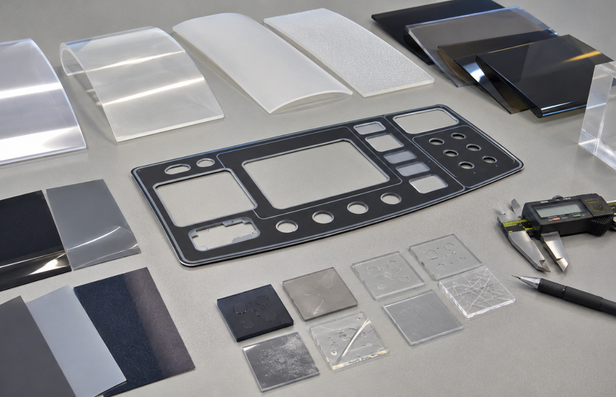
In OEM applications, the overlay must withstand years of chemical exposure, UV light, cleaning agents, temperature fluctuations, abrasion, and millions of actuations. Polycarbonate (PC) and polyester (PET) together account for more than 85% of all graphic overlay applications worldwide, and the choice between them alone can change the product's lifespan by an order of magnitude.
Choosing the right graphic overlay manufacturer is not a procurement decision. It is an engineering decision that affects warranty, brand perception, and field reliability for the life of the product.
Material and Substrate Questions
The material is the foundation of every overlay. The wrong substrate cannot be saved by good printing.
Questions to ask:
- What graphic overlay materials do you offer (polycarbonate, polyester, acrylic others)
- When do you recommend polycarbonate (PC) vs polyester (PET)
- Do you offer a durable PET graphic overlay option for high-actuation or harsh environments
- How do you handle UV, chemical, and abrasion resistance
- Do you offer hard coats, matte, gloss, velvet, and anti-glare finishes
- Can you recommend a substrate based on our temperature, chemical, and user environment
Quick reference for OEMs:
- PET typically supports about 1 million actuations and offers strong chemical and abrasion resistance with a hard coat
- PC typically supports about 100,000 actuations and offers easier embossing, good optical clarity, and built-in flame retardance
- PET is generally chosen for its long life and chemical exposure
- PC is generally chosen for embossed graphics, lower flex applications, and cost-sensitive designs
A strong manufacturer will not just answer these questions. They will recommend the right material for the application.
Printing and Process Questions
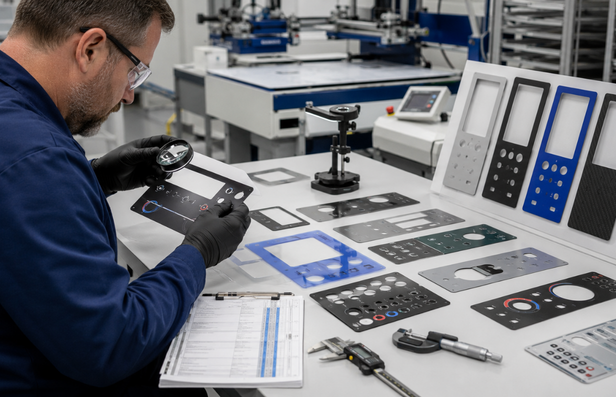
Once the material is right, the printing process decides how the overlay looks and how long it lasts.
Questions to ask:
- Do you offer screen printing, digital printing, or both
- For our application, which process do you recommend and why
- Do you support sub-surface (second surface) printing for chemical and abrasion resistance
- Can you support embossing, debossing, selective texturing, and back lighting
- How do you handle hard coats and protective top coats
- How do you ensure color consistency across lots and over time
What good answers look like:
- Screen printing is recommended for strong durability, high-volume production, and precise light blocking for back-lit interfaces
- Digital printing is recommended for complex imagery, variable data, and fast iteration
- Subsurface printing protects the ink from wear by printing on the back side of a transparent substrate
- Color is matched to a defined standard, controlled per lot, and documented
For a deeper look at processes and finishes, read our guide on graphic overlay printing techniques and finishes.
Design and Engineering Support Questions
A good manufacturer should make your design stronger, not just build it.
Questions to ask:
- Do you offer design for manufacturability (DFM) review
- Can you support our team during graphic overlay design
- What artwork file formats do you require, and what tolerances do they need to meet
- Will you flag risks (tight tolerances, weak adhesives, sourcing issues) before production starts
- Can you support custom graphic overlays with mixed materials, multi-layer construction, and special finishes
- Do you have experience integrating overlays with membrane switches, touch screens, or displays
A custom graphic overlay manufacturer that offers real DFM input will quietly save you money on every order.
Tolerance, Quality, and Certification Questions
Tolerances and certifications are where vague promises become measurable expectations.
Questions to ask:
- What are your dimensional, color, and emboss height tolerances
- Are you ISO 9001 certified
- If we are in regulated industries, are you ISO 13485 (medical) or IATF 16949 (automotive) certified
- Do you use UL 969 recognized materials and inks
- What inspection and testing do you perform on every lot
- Can you provide material certifications, traceability, and inspection reports
- How do you handle non-conforming products and field failures
UL 969 in particular is important because it validates marking durability, adhesion, and performance under stress, and using UL-recognized materials simplifies OEM product approvals.
For more on how this works in practice, see our guide on how quality and process define overlay reliability.
Production, Capacity, and Lead Time Questions
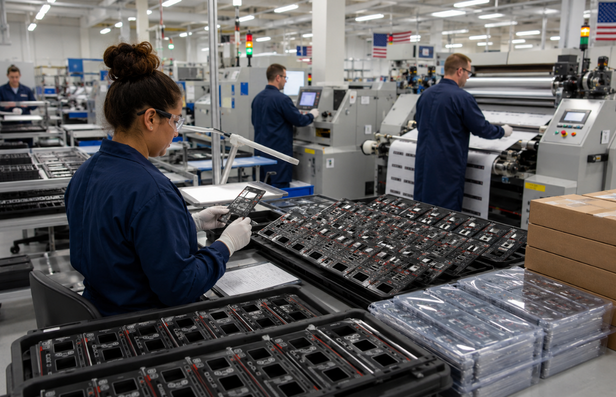
A great prototype means nothing if the supplier cannot scale.
Questions to ask:
- What are your typical lead times for prototypes
- What are your lead times for production orders
- What is your minimum order quantity (MOQ)
- What is your production capacity per week or per month
- How do you handle rush orders, scheduled releases, and demand changes
- Are you set up to support full scale production, not just samples
Ask specifically whether the manufacturer can support the full lifecycle of your product, from prototype to ramp-up to ongoing production.
Pricing and Total Cost Questions
The cheapest piece price is not always the cheapest order.
Questions to ask:
- How is your pricing structured
- What is included in the quoted price (tooling, setup, samples), and what is extra
- Do you offer pricing tiers at higher volumes
- How do you compare on total cost per unit delivered, including freight, rework, and rejects
- Do you support kitting, packaging, and scheduled deliveries
Always compare quotes on total cost per delivered, accepted unit, not just on price per piece.
Supply Chain and Sourcing Questions
The overlay is only as reliable as the supply chain behind it.
Questions to ask:
- Where are your raw materials sourced from
- Are you a graphic overlay manufacturer in the USA, or do you produce offshore
- How do you handle material shortages, lead time changes, or supplier disruptions
- Can you source and qualify custom or hard-to-find substrates
- Do you maintain safety stock for high-volume customers
For OEMs that value tighter quality control, easier communication, faster lead times, and stronger compliance support, working with a graphic overlay manufacturer in the USA is often the more practical choice.
Communication and Project Management Questions
Day-to-day communication often decides whether a project ships on time or quietly slips.
Questions to ask:
- Who is our main point of contact during the project
- How do you handle revisions, change orders, and approvals
- How quickly can we expect quotes, samples, and engineering responses
- How do you communicate delays, quality issues, and risks
- Are you available by phone, email, and video for engineering reviews
A reliable manufacturer treats communication as part of the product.
Industry Experience and References
Experience in your specific industry is worth more than generic claims.
Questions to ask:
- What industries do you typically serve
- Can you share examples of similar custom graphic overlay projects
- Can you connect us with references in our industry
- Have you supported OEM graphic overlays for medical, industrial, automotive, or aerospace applications
- Do you have case studies or product photos we can review
A strong manufacturer will introduce you to satisfied customers in your space without hesitation.
Red Flags to Watch For
While interviewing potential partners, watch for signals that suggest risk later.
- No DFM input, only price quotes
- No certifications, quality documentation, or material traceability
- Vague answers about materials, finishes, or tolerances
- Pricing that is far below market, without a clear reason
- Slow, evasive, or inconsistent communication
- No willingness to provide references or sample work
Any one of these is a warning. Multiple is a clear sign to keep looking.
A Simple Graphic Overlay Buying Checklist
Use this short checklist before placing an order:
- Quality certifications verified
- Materials and finishes confirmed in writing
- Tolerances documented and agreed upon
- Tooling, prototype, and approval plan defined
- Lead times, MOQs, and capacity confirmed
- Inspection and quality plan in place
- Communication, project ownership, and the escalation path are clear
- References, case studies, or sample work reviewed
This single checklist eliminates most overlay procurement risk.
Applications Across OEM Manufacturing
Strong graphic overlay design is critical in:
- Medical devices and diagnostic equipment
- Industrial controls and HMIs
- Aerospace and defense interfaces
- Automotive dashboards, infotainment, and controls
- Consumer appliances and smart home devices
- Custom OEM front panels, labels, and nameplates
In every one of these, the overlay is the product to the user, even if it is only one part of the system.
How to Choose the Best Graphic Overlay Manufacturer
The best graphic overlay manufacturer is not always the largest or the cheapest. It is the one that aligns with the way you actually build products.
Look for a partner that offers:
- Real engineering depth and DFM support
- In house printing, lamination, embossing, and finishing
- Material and process expertise across PC, PET, and specialty films
- Quality systems built for OEM and regulated industries
- Scalability from prototype to full scale production
- Honest communication and a track record of references
A good partner shapes your overlay design, not just your invoice.
Key Takeaways
- The questions you ask before ordering decide the quality and reliability of every overlay you ship
- Materials, printing process, tolerances, and certifications matter more than price alone
- PET supports about 1 million actuations and excels in chemical and abrasion resistance
- PC supports about 100,000 actuations and is ideal for embossed, lower flex, optically clean applications
- The best graphic overlay manufacturer acts as an extension of your engineering team
- A short, structured checklist of questions protects the budget, schedule, and field performance
How We Support OEMs at Butler Technologies, Inc. (BTI)
At Butler Technologies, Inc. (BTI), graphic overlay manufacturing is a core capability built around OEM and engineering needs.
Capabilities include:
- In-house graphic overlay manufacturing in the USA
- Polycarbonate, polyester (PET), and custom substrate expertise
- Design support, DFM review, and engineering collaboration
- Screen and digital printing, embossing, hard coats, and lamination
- Quality systems for medical, industrial, automotive, and aerospace applications
- Scalable production from prototypes through full scale production
- Single partner support from concept to delivery
The goal is simple. Give OEMs a graphic overlay partner that gets the design right the first time and keeps it right at every quantity.
Have a project in mind? Request a quote from Butler Technologies.
Frequently Asked Questions (FAQs)
What questions should I ask a graphic overlay manufacturer before ordering?
The most important questions cover materials, printing process, tolerances, certifications, lead times, MOQs, design and DFM support, pricing structure, supply chain, communication, and references. A strong manufacturer will answer all of these clearly and in writing.
How do I choose a graphic overlay manufacturer?
Choose a manufacturer based on engineering depth, in-house printing and finishing capability, material and process expertise, quality systems, scalability from prototype to full scale production, and proven references in your industry. Price is one factor, but never the deciding one.
What is the best material for a graphic overlay?
It depends on the application. Polyester (PET) is typically chosen for long life, high actuation counts, and strong chemical and abrasion resistance. Polycarbonate (PC) is typically chosen for embossed graphics, optical clarity, easier forming, and cost-sensitive designs.
What is the difference between polycarbonate and polyester (PET) overlays?
PET overlays generally support around 1 million actuations and offer superior chemical and abrasion resistance with a hard coat. PC overlays generally support around 100,000 actuations, are easier to emboss, and offer good optical clarity and inherent flame retardance. Together, PC and PET account for more than 85% of graphic overlay applications globally.
Why choose a graphic overlay manufacturer in the USA?
A graphic overlay manufacturer in the USA, such as Butler Technologies, Inc. (BTI), typically offers tighter quality control, faster communication, shorter lead times, stronger compliance support, and easier collaboration on design, DFM, and full-scale production. For OEMs in regulated industries, these advantages often outweigh small differences in offshore unit price.