

In the world of product design, the human-machine interface (HMI) is more than just a control panel; it is the bridge between human intent and machine action. Whether it is a life-saving medical device or a rugged industrial controller, the HMI defines the user experience.
At Butler Technologies, Inc. (BTI), we approach HMI design not just as manufacturers, but as engineering partners. We understand that a successful interface requires a convergence of material science, mechanical engineering, and user-centred design.
This guide breaks down the technical anatomy of an HMI, providing engineers and designers with a clear understanding of the components that drive reliability and functionality.
1. The Graphic Overlay: The Face of the Interface
The graphic overlay is the outermost layer of the HMI. While it carries the brand's aesthetic, its primary engineering function is protection. It shields the sensitive electronics underneath from moisture, abrasion, and chemicals.
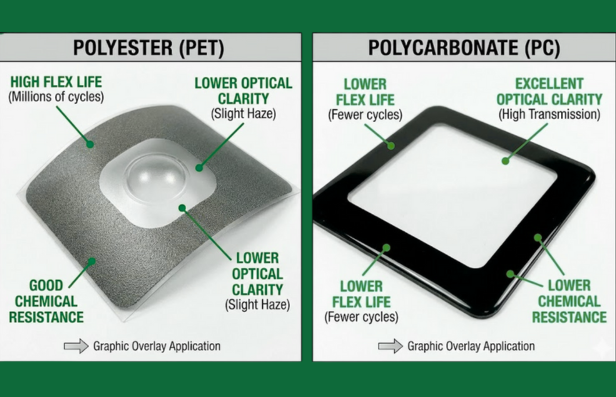
Material Selection: Polyester (PET) vs. Polycarbonate (PC)
The most critical decision in overlay design is selecting the right substrate. While they look similar, their performance under stress differs significantly.
- Polyester (PET): This is the industry standard for high-reliability membrane switches. PET is semi-crystalline, meaning it resists flexural fatigue. It can withstand over one million actuation cycles without cracking, making it essential for tactile buttons.
- Polycarbonate (PC): While offering superior optical clarity and ease of die-cutting, PC is amorphous and prone to fatigue. It typically fails (cracks) after approximately 100,000 cycles if used over a tactile dome. Therefore, we recommend PC primarily for non-tactile displays or rigid windows.
Quick Comparison for Material Selection:
%20and%20Polycarbonate%20(PC)%20material%20properties..png?width=1024&height=900&name=Table%20comparing%20Polyester%20(PET)%20and%20Polycarbonate%20(PC)%20material%20properties..png)
The Adhesive Layer
Below the overlay lies the adhesive, which must seal the switch against the environment. We typically utilise 3M high-performance acrylic adhesives:
- 3M 467MP (200MP Family): The standard for attaching graphic overlays to smooth metal or high-surface-energy plastics. It offers excellent shear strength and withstands temperatures up to 204°C.
- 3M 300LSE: Required when bonding to low-surface-energy (LSE) plastics like polypropylene or powder-coated paints, which resist standard adhesives.
2. The Switching Mechanism: Tactile vs. Touch
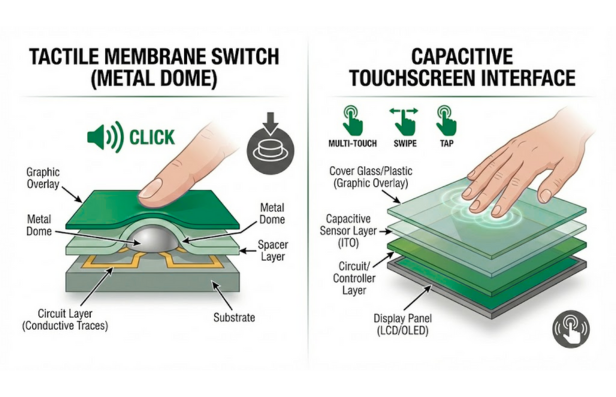
The core function of an HMI is to register input. This is typically achieved through either a mechanical membrane switch or a touch screen.
Membrane Switches
A membrane switch is a momentary electrical switch activated by physical pressure.
- Tactile Feedback: Most users prefer a physical "snap" or click. We achieve this using metal domes (stainless steel) or polydomes (embossed plastic). Metal domes are preferred for reliability, typically rated for >1 million cycles with actuation forces ranging from 180g to 700g.
- Non-Tactile: These switches have no snap and are silent. They rely on visual (LED) or auditory (beep) feedback to confirm the input. They are incredibly durable (rated for >5 million cycles) because there are no moving parts to fatigue.
Touch Screen Integration
For dynamic interfaces, we often integrate touch screens.
- Resistive: Relies on pressure. It works with gloves and water, making it ideal for heavy industrial use.
- Capacitive (PCAP): Relies on electrical coupling (like a smartphone). It offers multi-touch capabilities and superior optical clarity, but it can be sensitive to water droplets.
To decide which technology fits your specific project requirements, read our full comparison of Capacitive vs. Resistive Touch Screens.
BTI Design Tip: For mission-critical applications (like medical or military), we often recommend a hybrid approach: a touch screen for navigation and discrete membrane switches for "emergency stop" or power functions, ensuring operation even if the screen fails.
3. Circuitry: The Nervous System
The signals from the user are carried by the circuit layer. At BTI, we specialise in printed electronics, utilising conductive inks to create flexible, low-profile circuits.
Silver vs. Copper Flex
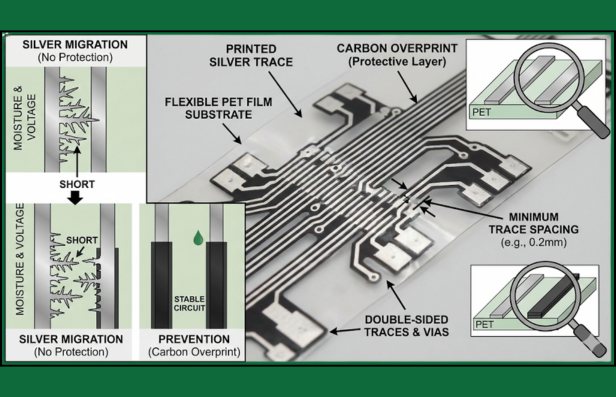
- Screen Printed Silver: The most common and cost-effective method. Conductive silver ink is printed onto a polyester sheet. Carbon ink is often printed over the silver to protect it from oxidation and abrasion.
- Copper Flex (FPC): Uses etched copper on Polyimide (Kapton). While more expensive, it is required for high-density traces (0.5mm pitch) or when soldering standard surface-mount (SMT) components is necessary.
Problem Solving: Preventing Silver Migration
A common failure mode in printed electronics is silver migration, where silver ions "grow" between traces under moisture and voltage, causing shorts.
How do we prevent it?
- Carbon Overprint: Covering silver traces with inert carbon ink blocks moisture.
- Trace Spacing: Maintaining adequate distance between tracks reduces the electric field.
- D/SPC (Double-Sided Polymer Circuitry): Printing traces on opposite sides of the film eliminates the migration path.
4. Connectivity: The Tail and Connector
The "tail" connects the HMI to the device's PCB. The choice of connector dictates the durability of this link.
- ZIF (Zero Insertion Force): A flat tail with exposed contacts that slides into a connector on the PCB. It is low-profile and cost-effective but relies on friction.
- Crimp Connectors (Nicomatic/Berg): Metal pins are crimped through the tail layers. This creates a gas-tight mechanical lock, offering superior vibration resistance. This is often the preferred choice for rugged environments.
5. Environmental Hardening
Industrial and medical HMIs must survive harsh worlds.
- IP67 Sealing: To make a switch waterproof (IP67), we utilise a continuous perimeter seal of adhesive. We also employ a "tail filler"—a small piece of plastic inserted where the tail exits the part—to plug the gap and prevent moisture ingress.
- EMI Shielding: To block Electromagnetic Interference, we print a grid of silver ink or laminate an aluminium foil layer into the switch stack. This shield must be grounded to the chassis to function effectively.
6. Advanced Capabilities: Beyond the Switch
At Butler Technologies, we leverage our printed electronics capabilities to add value beyond simple switching.
- Biometric Sensors: We print stretchable conductive inks on soft substrates (like TPU) to create wearable sensors that monitor heart rate or muscle activity (sEMG).
- Printed Heaters: Using Positive Temperature Coefficient (PTC) inks, we create flexible, self-regulating heaters for medical wearables or outdoor gear (e.g., the Team USA Heated Jacket).
- Force Sensing Resistors (FSR): These printed components change resistance based on how hard they are pressed, allowing for variable speed control or occlusion detection in medical pumps.
HMI Engineering FAQs
Q. What is the main purpose of a Human-Machine Interface (HMI)?
A. The purpose of an HMI is to allow users to control, monitor, and receive feedback from a machine or system through a physical interface such as buttons, touchscreens, or sensors.Q. What are the key components of an HMI?
A. The key components of an HMI include graphic overlays, tactile feedback elements, printed electronic circuits, sensors, backlighting systems, and environmental sealing.
Q. Why are graphic overlays important in HMIs?
A. Graphic overlays protect internal electronics while providing visual guidance, durability, and environmental resistance. They are critical for usability and long-term reliability.Q. How do membrane switches differ from capacitive touchscreens in HMIs?
A. Membrane switches rely on physical contact to close circuits and are highly sealed and durable, while capacitive touchscreens detect changes in electrical fields and allow multi-touch input.Q. What role do sensors play in modern HMIs?
A. Sensors enable advanced functions such as pressure detection, touch sensitivity, and biometric feedback, allowing HMIs to respond intelligently to user interaction.Ready to design your next interface? As a design-driven manufacturer, Butler Technologies is ready to help you navigate these choices, from prototyping to full-scale production.