

Touch screen interfaces are widely associated with consumer devices, but in industrial, medical, and rugged environments, reliability and precision matter far more than gesture support or glass aesthetics. This is why resistive touch screen technology continues to be a trusted solution across many mission-critical applications.
Resistive touch screens are valued for their predictable performance, compatibility with gloves and styluses, and ability to function in harsh conditions. For OEMs and product engineers, understanding how resistive touch screens work and where they outperform alternatives is essential for making the right interface decision.
What Is a Resistive Touch Screen?
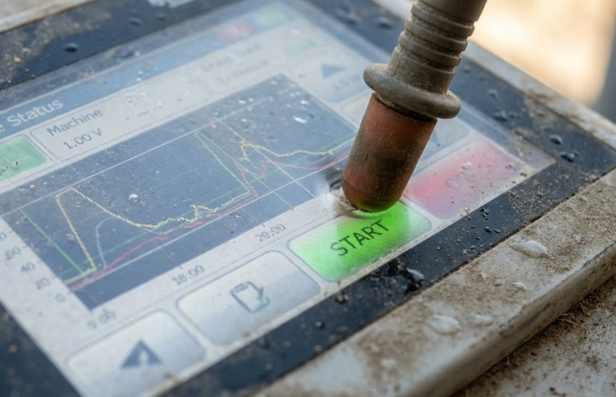
A resistive touch screen is a pressure-based touch screen that registers input when physical force causes two conductive layers to make contact. Unlike capacitive systems, resistive technology does not rely on the electrical properties of the human body.
This makes resistive touch screens especially effective in environments involving:
- Gloves or protective equipment
- Moisture, dust, or chemical exposure
- Stylus or tool-based input
- High precision interface requirements
While resistive screens are the go-to choice for rugged and pressure-based applications, it's helpful to understand how they stack up against the interfaces we use on modern smartphones and tablets. If you're curious about the other side of touch technology, read our breakdown of the Types and Benefits of Capacitive Touch Screens.
How Do Resistive Touch Screens Work?
To understand how resistive touch screens work, it helps to look at their layered construction.
A typical resistive touch screen includes:
- A flexible top layer with a transparent conductive coating
- A rigid bottom layer with a conductive surface
- Spacer dots that prevent unintended electrical contact
When pressure is applied:
- The top layer bends toward the bottom layer
- The two conductive surfaces touch
- Electrical resistance changes at the contact point
- The controller calculates the X and Y coordinates
Because input is pressure-based, resistive touch screens operate consistently whether input comes from a finger, glove, or stylus.
Resistive Touch Screen Working Principle
The resistive touch screen working principle is based on voltage division and resistance measurement.
In simple terms:
- Voltage is applied across the conductive layers
- Pressure creates a closed circuit
- Voltage changes are detected
- Touch location is calculated
This simple electrical behavior makes resistive touch screen technology:
- Stable over time
- Highly accurate
- Less sensitive to environmental interference
While the electrical principle is straightforward, real-world performance depends heavily on panel construction, material selection, controller integration, and manufacturing precision. For a deeper look at how custom touch screen panels are engineered for durability and functionality, explore our guide to Custom touch screen panel design and manufacturing.
Types of Resistive Touch Screens
There are two primary types of resistive touch screens used in industrial and medical applications.
4-Wire Resistive Touch Screen
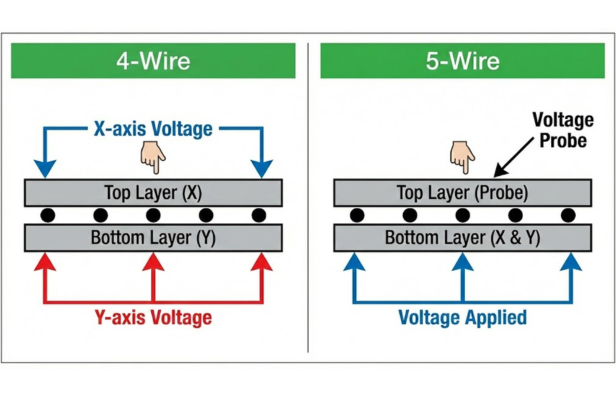
The 4-wire resistive touch screen uses electrodes on both the top and bottom layers to measure voltage changes.
4-wire resistive touch screen working principle
- Voltage is applied across the X axis
- Voltage is then applied across the Y axis
- Touch position is calculated from the voltage drop
Advantages
- Lower cost
- Simple construction
- Suitable for low to moderate cycle applications
Limitations
- Top layer participates in sensing
- Increased wear over time
- Shorter operational lifespan
5-Wire Resistive Touch Screen
The 5-wire resistive touch screen is designed for higher reliability and longer life.
5-wire resistive touch screen working principle
- Voltage is applied only to the bottom glass layer
- The top layer acts as a voltage probe
- Signal accuracy remains stable even with surface wear
Advantages
- Superior durability
- Higher long-term accuracy
- Minimal recalibration
- Preferred for industrial and medical environments
Limitations
While highly reliable, 5-wire resistive touch screens do have some limitations that engineers should account for:
- Higher cost compared to 4-wire resistive touch screens
- Slightly more complex controller requirements
- Single touch input only, no native multi-touch support
- Lower optical clarity than capacitive touch screens due to layered construction
Despite these trade-offs, the stability and longevity of 5-wire systems make them ideal where downtime, recalibration, or input failure is unacceptable.
Because of this reliability, the 5-wire resistive touch screen is widely used in applications where consistent performance is critical.
Resistive Touch Screen Technology Overview
Resistive touch screen technology is valued for its simplicity and predictability.
Key characteristics include:
- High positional accuracy
- Low power consumption
- Resistance to EMI and electrical noise
- Consistent performance in harsh environments
This makes resistive technology easier to integrate and validate in regulated products.
Resistive vs Capacitive Touch Screen
A common design decision involves choosing between resistive vs capacitive touch screen technology.
Resistive touch screens
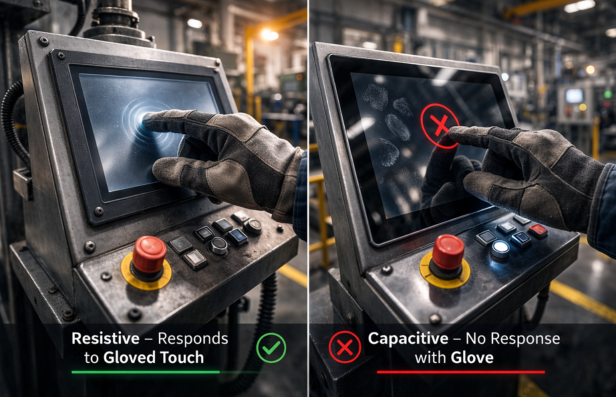
- Respond to pressure
- Work with gloves and styluses
- Perform reliably in wet or dirty conditions
- Offer precise control for small interface elements
Capacitive touch screens
- Respond to conductive touch
- Support multi-touch gestures
- Provide higher optical clarity
- Require bare fingers or specialized gloves
For consumer devices, capacitive dominates.
For industrial and medical products, resistive remains the practical choice.
Advantages of Resistive Touch Screens
The advantages of resistive touch screens explain their continued adoption.
Key benefits include:
- Works with gloves, tools, and styluses
- Reliable in harsh and contaminated environments
- High precision for small UI elements
- Lower susceptibility to false touches
- Long service life with proper design
These strengths align closely with industrial and medical interface requirements.
Resistive Touch Screen Applications
Resistive touch screen applications span multiple industries where reliability matters more than gesture support.
Common use cases include:
- Industrial control panels and HMIs
- Medical surgical devices and monitoring equipment
- Laboratory instruments
- Point of sale terminals
- Transportation and marine systems
- Factory automation interfaces
In these environments, pressure-based touch input ensures dependable operation.
Design Considerations for OEMs
When designing interfaces with resistive touch screens, OEMs should account for:
- Button size and spacing for gloved use
- Touch force requirements
- Graphic overlay durability
- Environmental exposure conditions
Resistive technology integrates well with custom graphic overlays and printed electronics for long-term performance.
At Butler Technologies, we support OEMs with durable interface solutions, including custom touch screen solutions, resistive and capacitive integration, and a range of printed electronics options. Our engineering-driven approach ensures long-term reliability, consistent performance, and seamless integration in demanding industrial and medical environments.
If you are evaluating resistive touch screen technology for your next product, Butler Technologies can help you select, design, and manufacture an interface solution that aligns with your application requirements and lifecycle expectations.
Frequently Asked Questions (FAQs)
1. How do resistive touch screens work?
They detect pressure that causes two conductive layers to touch, allowing the controller to calculate touch position based on resistance changes.
2. What are the types of resistive touch screens?
The two main types are 4-wire and 5-wire resistive touch screens, with 5-wire offering greater durability and accuracy.
3. What is the advantage of resistive touch screens over capacitive?
Resistive screens work with gloves and styluses and perform reliably in harsh environments.
4. Where are resistive touch screens commonly used?
They are commonly used in industrial, medical, laboratory, transportation, and rugged interface applications.