

Summary
Membrane switch emboss types play an important role in how users identify, press, and interact with buttons on an interface. Choosing the right emboss style helps improve usability, tactile response, durability, and overall product performance.
In this blog, you’ll learn:
- What embossed buttons are in the membrane switch design, and why they matter
- The key differences between pillow emboss, rim emboss, and dome emboss
- How each emboss type affects tactile feedback, button visibility, and user interaction
- When to use pillow emboss for balanced performance and clear button identification
- When rim emboss is better for dense layouts, industrial controls, and eyes-free operation
- When the dome emboss is ideal for round buttons, precise targeting, and enhanced tactile feel
- How emboss height, spacing, radius, and material selection impact durability
- Common emboss design mistakes that can lead to cracking, poor bonding, or higher production costs
Membrane switch emboss design is more than a visual detail. The right emboss type supports better usability, longer-lasting performance, and a more reliable interface across industrial, medical, and electronic applications.
When designing a membrane switch, most attention goes to circuit layers and tactile response. But one critical factor that directly impacts usability, durability, and user experience is often overlooked: button embossing.
Embossed buttons transform a flat interface into something intuitive, tactile, and easy to operate, especially in industrial, medical, and high-use environments.
In this guide, we’ll break down the three most common emboss types and help you choose the right one for your application.
What Are Embossed Buttons in Membrane Switches?
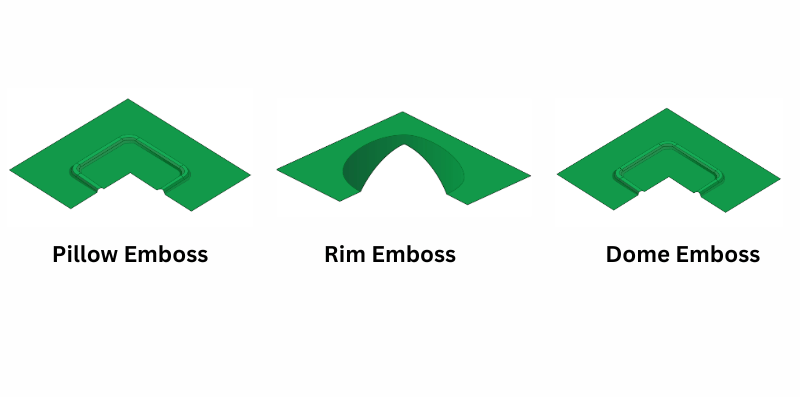
Embossed buttons are raised features formed into the graphic overlay of a membrane switch. Instead of flat keys, embossing creates a three-dimensional surface that improves both visual identification and tactile interaction.
The three primary emboss styles include:
- Pillow Emboss
- Rim Emboss
- Dome Emboss
Each serves a different functional and membrane switch design purpose.
Types of Embossing in Membrane Switches
Pillow Emboss
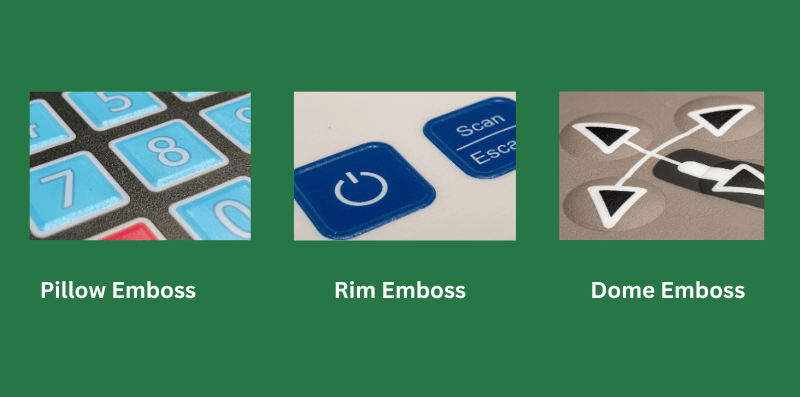
Pillow embossing raises the entire button area while keeping the top surface flat.
Best for:
- Clear button visibility and identification
- Balanced tactile response
- General-purpose applications
Why it works:
- Provides a consistent press surface
- Supports higher tactile force dome switches
- Enhances both look and usability
Rim Emboss
Rim embossing creates a raised border around the button while keeping the center flat.
Best for:
- Dense keypad layouts
- Eyes-free operation
- Industrial control panels
Why it works:
- Helps users locate button boundaries quickly
- Improves accuracy in multi-button interfaces
- Can reduce overall switch construction layers and cost
Dome Emboss
Dome embossing forms the entire button into a rounded, spherical shape.
Best for:
- Round buttons
- High tactile targeting
- Premium user experience
Why it works:
- Provides a clear “target point” for pressing
- Enhances tactile precision
- Offers stronger perceived feedback
Emboss selection also connects closely with switch feedback. For example, tactile switches often benefit from emboss designs that improve button recognition and press confidence, while non-tactile switches may rely more on visual or audio confirmation.
If you are still evaluating the right feedback style for your interface, our detailed guide on
Tactile vs. Non-tactile membrane switches can help clarify how each option affects usability, durability, and user experience.
Key Design Considerations for Embossed Buttons
Choosing an emboss type is not just about shape. Engineering constraints matter.
1. Emboss Height
- PET: ~1.0x material thickness
- Polycarbonate: ~1.5x material thickness
Higher embossing increases failure risk if not controlled.
2. Width and Spacing
- Rim emboss width: 0.040” to 0.050”
- Minimum spacing: ~0.187”
Proper spacing ensures structural integrity and adhesive bonding.
3. Radius
- Minimum corner radius: 0.032”
Sharp edges increase cracking risk in overlay materials.
4. Backlighting Impact
Embossing can thin the material and affect light diffusion. This must be considered early in design.
When to Choose Each Emboss Type
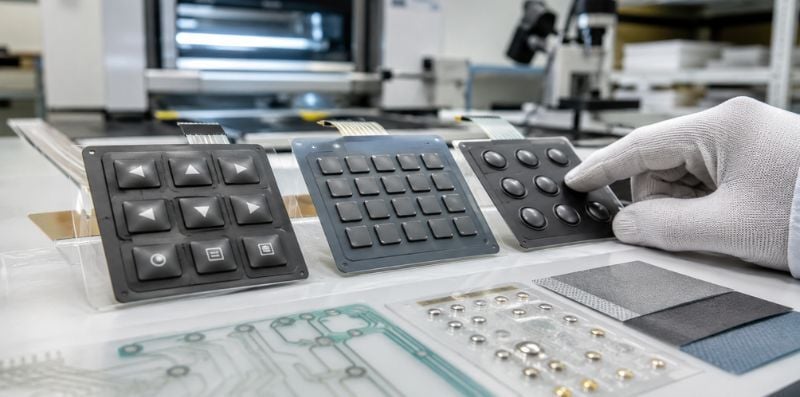
Choose Pillow Emboss If:
- You want strong visual and tactile identification
- You’re using high-force tactile domes
- You need a balanced, all-purpose design
Choose Rim Emboss If:
- Your user interface has multiple buttons close together
- Users rely on touch more than sight
- You want to reduce costs and simplify construction
Choose Dome Emboss If:
- You need precise button targeting
- Your buttons are round
- You want enhanced tactile response
If your design uses tactile domes, understanding membrane switch domes can help clarify how dome type, actuation force, travel, and feedback response affect overall keypad performance.
Cost and Manufacturing Considerations
Not all emboss types are equal in cost:
- Pillow and Rim embossing are typically more cost-efficient
- Dome embossing requires more complex tooling and processing
- Rim embossing can sometimes reduce the overall layer count
These factors directly impact production scalability and pricing.
Common Mistakes to Avoid
- Over-embossing beyond material limits
- Ignoring spacing requirements
- Using sharp corners instead of a proper radius
- Not accounting for backlighting effects
- Choosing emboss style based only on aesthetics
Making the Right Emboss Choice
Embossing is more than a visual design choice. It directly affects usability, durability, and overall product performance.
Selecting the right emboss type early in the design process can prevent costly redesigns and improve the end-user experience.
If you're developing a membrane switch interface, making the right emboss decision can make all the difference.
The right emboss type depends on how your product is used:
- Choose Pillow Emboss for balanced performance and strong visibility
- Choose Rim Emboss for industrial layouts and cost efficiency
- Choose Dome Emboss for precision and a premium tactile experience
How We Help at Butler Technologies
At Butler Technologies, we work closely with engineers and product teams to design membrane switches that balance performance, durability, and user experience.
From emboss selection to full interface design, we help ensure your product performs reliably in real-world conditions.
Frequently Asked Questions (FAQs)
What are the main membrane switch emboss types?
The main membrane switch emboss types are pillow emboss, rim emboss, and dome emboss. Each type changes the shape of the button area and affects tactile feel, button visibility, usability, and manufacturing complexity.
What is pillow emboss in a membrane switch?
Pillow emboss raises the entire button area while keeping the top surface mostly flat. It is commonly used when a membrane switch requires clear button identification, balanced tactile feedback, and a clean, uncluttered interface.
What is the difference between pillow emboss and rim emboss?
Pillow emboss raises the entire button area, while rim emboss raises only the border around the button. Pillow emboss is better for strong visual button definition, while rim emboss is useful for dense layouts and eyes-free operation.
When should you use a dome emboss?
Dome emboss is best for round buttons or applications that need precise tactile targeting. It creates a rounded button shape that helps users locate and press the button more easily.
How do you choose the right membrane switch emboss type?
The right emboss type depends on button shape, user interaction, spacing, tactile requirements, material limits, and manufacturing cost. Pillow emboss works well for general use, rim emboss is useful for compact industrial layouts, and dome emboss is ideal for precise button targeting.