

Touch screen panels are now essential across consumer electronics and industrial applications. Whether in smartphones or rugged equipment, these interfaces rely on a precise blend of layered materials, sensor technology, and manufacturing techniques.
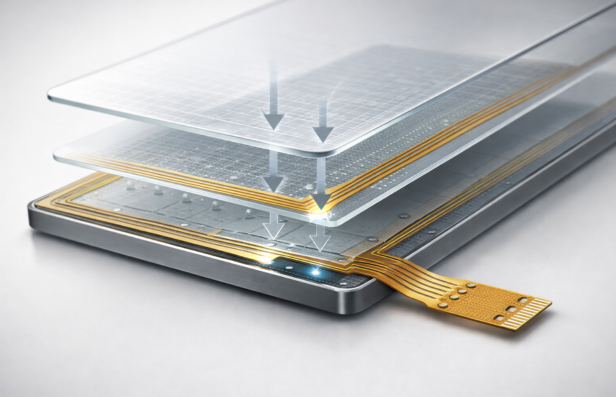
At their core, touch panels combine a display with sensor layers and often a protective cover that detects finger or stylus input.
The two most common types are resistive and capacitive touch panels:
- Resistive panels: utilize two conductive layers (typically indium-tin-oxide or ITO) separated by micro-spacers. Pressing the top layer completes the circuit.
- Capacitive panels: feature a transparent electrode grid that senses changes in capacitance when touched.
Manufacturing these panels involves steps like glass cleaning, ITO coating, electrode patterning, and lamination, resulting in thin, durable interfaces that convert touch into signals.
Resistive Touch Panels
Resistive touchscreens were among the first widely adopted in the market. They consist of:
- Two flexible ITO-coated sheets (plastic and glass/acrylic)
- An air gap or printed spacer dots to keep the sheets apart
- Conductive bars along the edges for voltage application
How they work:
When pressed together, the two layers form a voltage divider. The controller then reads the X and Y values to determine the touch location. These panels work with gloves or styluses and require light pressure.

Key Manufacturing Steps for Resistive Panels
1. ITO Coating
Applied via magnetron sputtering onto PET or glass under vacuum.
2. Patterning and Spacer Addition
The conductive layers are etched or masked, and spacer dots are printed.
3. Circuit Integration
Conductive inks or flex circuits are applied for signal routing.
4. Panel Lamination
The layers are aligned and bonded using pressure or adhesive.
The result is a multi-layered structure with high durability and consistent performance.
Capacitive Touch Panels
Capacitive touch screens are dominant in today’s touchscreen market, found in:
- Smartphones
- Tablets
- Medical monitors
- Industrial interfaces
Panel Structure
- Protective cover glass (chemically strengthened)
- Patterned ITO sensor glass layers
- Adhesive or air gap
- Display module (LCD/OLED)
There are two main design types:
- DITO (Dual ITO): Two glass sheets carry separate X and Y electrodes.
- SITO (Single ITO): One glass layer contains both electrode sets with cross-bridges.
How they work:
The electrode grid detects changes in capacitance when a finger approaches the surface, enabling precise and fast input detection.
Key Manufacturing Steps for Capacitive Panels
1. Glass Cleaning and ITO Deposition
Glass is cleaned using UV or laser treatment. ITO is applied via sputtering or evaporation.
2. Photoresist and Etching
UV-exposed photoresist creates the electrode pattern. The unprotected ITO is etched away.
3. Curing and Electrical Integration
Once patterned, glass is cured and connected to a controller via:
- Chip-on-Flex (COF)
- Chip-on-Board (COB)
4. Cover Glass Preparation
- Cut, ground, and strengthened glass receives:
- Anti-reflective coatings
- Oleophobic coatings (for smudge resistance)
- Optional anti-glare treatment
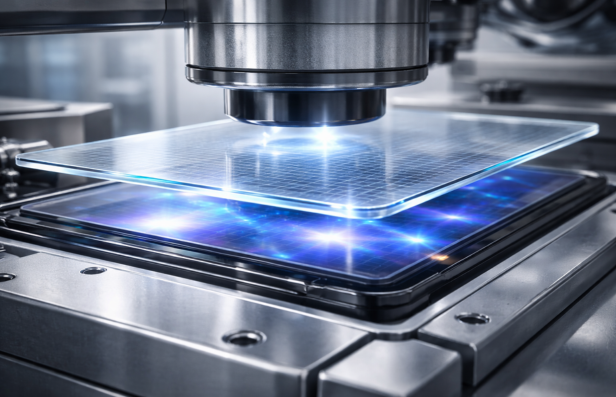
5. Optical Bonding and Assembly
Layers are aligned in a vacuum laminator, using either:
- Optically Clear Adhesive (OCA) film
- Liquid Optical Adhesive (LOCA)
The adhesive is cured (often with UV) to create a single, gapless panel that improves clarity and durability.
Touch Sensor Layers and ITO Coating
ITO coatings are the conductive backbone of touch panels.
- In Resistive Panels: ITO is coated onto flexible plastic films.
- In Capacitive Panels: ITO is sputtered onto glass substrates.
ITO Patterning and Quality Control
- After deposition, the ITO is patterned using photoresist and etching.
- Spacers and circuit layers are added with precision.
- Dust-free cleanroom environments are essential during this stage to avoid defects.
Final Assembly and Optical Bonding
After sensor layer prep:
1. Controller Connection
Flex cables or boards are bonded to sensor edges using anisotropic film or solder.
2. Optical Bonding
The panel layers (cover, sensor, LCD) are aligned in a vacuum and bonded:
- Removes air gaps
- Improves moisture resistance
- Enhances optical clarity
3. Curing
Adhesives are UV-cured for final hardening and integrity.
4. Inspection and Framing
Final touch modules undergo:
- Calibration
- Optical inspection
- Environmental stress testing
Edges may be framed or sealed, especially in industrial applications.
Precision and Scale in Production
- Clean environments are critical for ITO and photoresist steps.
- Even micron-level defects can cause failure.
- Automated systems control every step: sputtering, etching, alignment, and bonding.
- High-volume facilities can process thousands of panels daily.
Wrapping Up the Process
Creating a touch screen panel is a complex blend of science, precision, and innovation. From selecting the appropriate sensor type—resistive or capacitive—to applying transparent conductive coatings and executing precise photolithography, every stage demands tight control and technical expertise. Optical bonding further enhances the end product by improving durability, clarity, and environmental resistance.
For forward-thinking manufacturers and interface solution providers like Butler Technologies, understanding these core processes is essential to delivering dependable, high-performance touch-enabled systems.
With advanced materials, automated production lines, and stringent quality control, today's touch panels are built to support both rugged industrial environments and modern user expectations—ensuring functionality, resilience, and seamless user interaction.