

Summary
Force Sensing Resistors detect and measure applied force by converting pressure into electrical signals using thin, flexible sensing materials. They enable responsive, scalable, and cost-effective force detection across modern electronic and industrial systems.
In this blog, you’ll learn:
- What Force Sensing Resistors are and how they work
- What types of forces FSR sensors can detect, including static, dynamic, point, and distributed force
- How resistance changes with applied pressure to produce electrical output
- How FSR sensors detect and interpret different force levels
- The difference between FSR sensors and traditional pressure sensors
- Key applications in medical devices, consumer electronics, industrial systems, and automotive use cases
- Important design considerations like sensitivity, calibration, and environmental impact
Force Sensing Resistors play a critical role in enabling reliable force measurement, touch interaction, and pressure sensing in modern devices and interfaces.
Force sensing plays a critical role in modern electronics, from touch interfaces and wearable devices to industrial control systems. Among the most versatile technologies used for detecting force is the Force Sensing Resistor (FSR).
FSRs provide a simple and scalable way to detect different types of forces by converting physical pressure into an electrical response. Understanding what types of forces a force-sensing resistor can detect helps engineers design more responsive and reliable systems.
What Are Force Sensing Resistors
Force Sensing Resistors are sensors that change their resistance when force is applied to their surface.
An FSR sensor operates based on:
- decreasing resistance as force increases
- detecting both light touch and applied pressure
- producing an electrical output based on force levels
These sensors are widely used in:
- touch interfaces
- medical devices
- industrial controls
- wearable systems
At Butler Technologies, we design printed FSR solutions that enable flexible, low-profile force detection across a wide range of applications.
How Force Sensing Resistors Measure Force
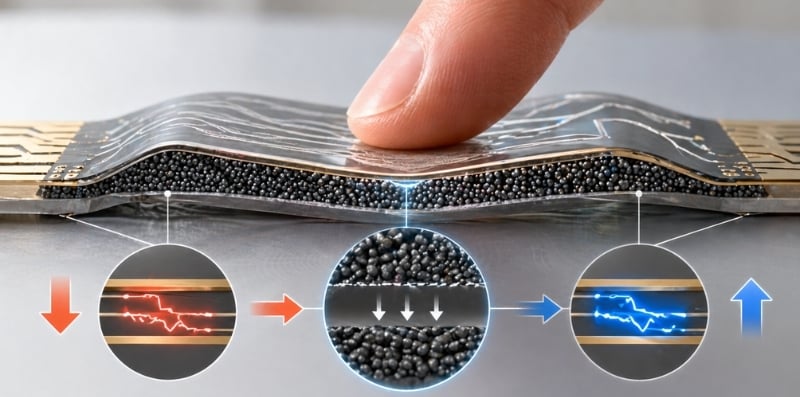
To understand force sensing resistor force measurement, it is important to look at how these sensors respond to applied force.
When force is applied:
- Conductive particles inside the sensor move closer together
- resistance decreases
- current flow increases
This change is then converted into a measurable electrical signal.
Key characteristics:
- The response is proportional, not perfectly linear
- suitable for relative force measurement
- capable of detecting a wide range of force levels
Types of Forces a Force Sensing Resistor Can Detect
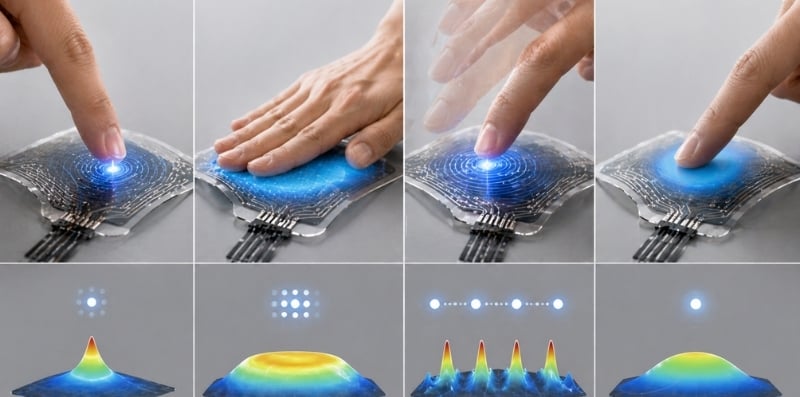
Force-sensing resistors can detect multiple types of forces depending on how they are designed and used.
1. Static Force
Static force refers to a constant pressure applied over time.
Examples include:
- sitting pressure on a seat
- steady load on a surface
2. Dynamic Force
Dynamic force involves changing or varying pressure.
Examples include:
- tapping or pressing a button
- Repeated force or impact
3. Point Force
Point force is a localized pressure applied to a small area.
Examples include:
- finger touch
- stylus input
4. Distributed Force
Distributed force is spread across a larger surface area.
Examples include:
- body weight distribution
- pressure across a seat or mat
5. Touch and Light Force
This refers to low-force interactions.
Examples include:
- touch-sensitive buttons
- light user inputs
To learn more about this process, see how force sensing resistors convert pressure to electrical signal.
Force Range and Sensitivity of FSR Sensors
The sensitivity of a force sensing resistor determines how accurately it responds to applied force.
Key factors include:
- minimum detectable force
- maximum force range
- response curve
- repeatability
Important considerations:
- FSR sensors are highly sensitive to light touch
- The response becomes less linear at higher force levels
- Calibration improves accuracy for specific use cases
How FSR Sensors Detect Different Force Levels
1. Force Application
Pressure is applied to the sensor surface.
2. Resistance Change
Internal resistance decreases based on force intensity.
3. Voltage Output
The change in resistance is converted into voltage by a circuit.
4. Signal Interpretation
The system reads the analog signal output to determine the force level.
To explore this process in more detail, including how FSR sensors measure both pressure and touch inputs, read this detailed guide on how force sensing resistors measure pressure and touch.

Applications of Force Sensing Resistors
The ability to detect different types of forces makes FSR sensors highly versatile.
1. Medical Devices
- patient monitoring systems
- rehabilitation equipment
- pressure-sensitive controls
2. Consumer Electronics
- touch interfaces
- wearable devices
- interactive controls
3. Industrial Systems
- control panels
- force-based automation
- operator input systems
4. Automotive Applications
- seat occupancy detection
- pressure-based controls
- interface systems
To understand how these technologies are implemented in real-world scenarios, explore our detailed guide on force sensing applications.
Force Sensing Resistor vs Pressure Sensor
FSRs are often compared with other pressure-sensing technologies.
Force Sensing Resistors
- Detect contact force directly
- Flexible and thin
- Cost-effective
Pressure Sensors
- measure pressure in fluids or gases
- provide higher precision
- used in enclosed systems
The choice depends on application requirements, accuracy needs, and operating environment.
Design Considerations for Force Detection Using FSRs
When you are product designing with FSR sensors, several factors must be considered.
Key design elements:
- sensor placement and force distribution
- surface material and contact area
- environmental conditions such as temperature and humidity
- signal conditioning and calibration
Proper design ensures:
- consistent performance
- reliable output
- long-term durability
FSR Pressure Sensing Insights
Force sensing resistors provide a flexible and scalable solution for detecting various types of forces, from light touch to distributed pressure.
Their ability to support applied force measurement, combined with ease of integration, makes them a strong choice for modern electronic systems.
As printed electronics continue to evolve, FSR technology will play an increasingly important role in enabling responsive and adaptive interfaces.
Frequently Asked Questions (FAQs)
What types of forces can a force-sensing resistor detect?
FSR sensors can detect static, dynamic, point, distributed, and light touch forces.
How do FSR sensors measure force?
They measure force by changing resistance based on applied pressure, which is converted into an electrical signal.
What is force sensing resistor sensitivity?
It refers to how responsive the sensor is to changes in applied force.
Where are force-sensing resistors used?
They are used in medical devices, touch interfaces, industrial systems, and automotive applications.
Are FSR sensors accurate?
FSR sensors are suitable for relative force measurement but are not ideal for high-precision applications.