

Summary
A single-zone force sensing resistor (FSR) is a thin, printed sensor with one active area whose resistance drops as force is applied. It reports total force on that zone as a single output, making it a low-cost, low-profile way to detect presence or measure pressure. This blog explains how it works, how it is built, and where it fits.
In this blog, you'll learn:
- What "single-zone" means in a force sensing resistor
- How an FSR changes resistance in response to force
- The layered, printed construction of a single-zone FSR
- The difference between single-zone and multi-zone sensors
- Common applications for single-zone FSRs
- How Butler Technologies, Inc. (BTI) builds consistent printed sensors
Choosing between single-zone and multi-zone really comes down to whether you need to know how much force or where it is applied, and this guide gives you a clear way to decide.
Force sensing resistors are one of the simplest and most useful printed sensors available, and the single-zone version is where most applications start. It answers a very common product question: how hard is something being pressed, without the cost or complexity of a full sensor array. Understanding how it works makes it clear why single-zone force sensing resistors show up in everything from medical devices to consumer electronics.
For product teams evaluating force sensing resistors as an input or measurement method, the single-zone sensor is the natural starting point, both conceptually and in most designs.
Quick answer: A single-zone force sensing resistor (FSR) is a thin, printed sensor with one active sensing area whose electrical resistance drops as force is applied to it. It reports the total force on that single zone as one output, making it a low-cost, low-profile way to detect presence, measure applied pressure, or create a force-sensitive button, without the complexity of a multi-zone array.
What "Single-Zone" Means
The "zone" refers to the sensing area. A single-zone FSR has exactly one active region that produces one output, no matter where within that region the force lands. Press anywhere on the active area, and the sensor reports the total force applied as a single value.
This is the key distinction from a multi-zone or matrix sensor, which divides the surface into many separately read regions to map where force is applied as well as how much. A single-zone sensor answers how much; it does not answer where. For a large number of applications, how much is the only question that matters, which is why single-zone sensors are so widely used.

How a Force Sensing Resistor Works
An FSR is built on a simple, reliable principle: its resistance changes with the force pressing on it. At rest, resistance is very high, effectively an open circuit. As force is applied, resistance drops, and the harder you press, the lower the resistance goes.
A simple circuit reads the changing resistance and converts it into a signal the device can interpret as a level of force. There are no moving parts, which is a large part of why FSRs are durable and thin.
The Construction of a Single-Zone FSR
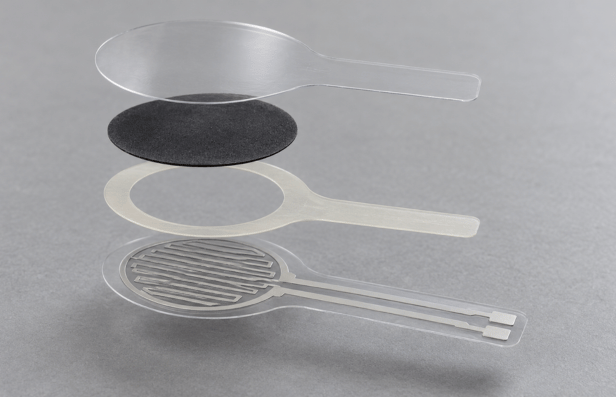
There are two common constructions of FSRs - the ShuntMode and the ThruMode. At Butler Technologies, Inc. (BTI), the ShuntMode is the most commonly produced version. A single-zone FSR is a layered, printed structure, which is what allows it to be so thin and flexible. The typical ShuntMode FSR construction is:
- A flexible substrate, such as polyester, on each side
- A conductive interdigitated electrode pattern on one layer
- A layer of force-sensitive resistive ink on the opposing layer
- A thin spacer around the active area, separating the two layers at rest
At rest, the spacer keeps the resistive layer and the electrodes slightly apart, so resistance is high. When force presses the layers together, the resistive material makes increasing contact with the electrode pattern, and resistance falls in proportion to the force. This printed, layered approach is a core part of BTI’s advanced printed technology capabilities, and the design rules that govern it are set out in IPC-2292A, the design standard for printed electronics on flexible substrates.
Single-Zone vs Multi-Zone: Which You Need
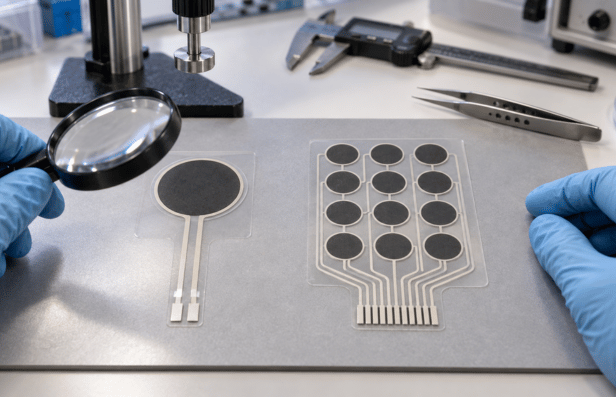
Choosing between single-zone and multi-zone comes down to one question: do you need to know where the force is applied, or only how much?
- Single-zone: one output, reports total force on the active area. Simpler, lower cost, easier to integrate.
- Multi-zone / matrix: many outputs, maps force location across a surface. More complex and costly, needed for position sensing.
If the application is a single force-sensitive button, a presence detector, or a pressure measurement at one point, single-zone is the right and more economical choice. Multi-zone is only justified when spatial mapping is genuinely required. Our force sensing resistor design guide covers the trade-off in more detail, along with the achievable force ranges for each construction.
Common Applications for Single-Zone FSRs
Single-zone force sensing resistors appear across a wide range of products because they solve a common problem cheaply and reliably:
- Force-sensitive buttons and controls, often specified as an alternative to a membrane switch where variable force matters
- Presence or occupancy detection
- Grip and pressure sensing in handheld and medical devices
- Safety interlocks that confirm something is being pressed or held
- Consumer electronics requiring variable-force input
- Wearables and equipment where thinness and flexibility matter, alongside printed biometric sensors
In each case, the product needs to know how much force is present at one location, and a single-zone FSR delivers that in a thin, durable, low-cost form.
Repeatability and What an FSR Is Not
An FSR is a force sensing device rather than a force measuring instrument, and the distinction matters when specifying one. Resistance response varies from part to part within a production run, and a sensor held under sustained load will drift. Neither is a defect. It is how the technology behaves.
This is why FSRs suit threshold detection, relative measurement and variable input, and why they are not the right choice when an absolute, traceable force reading is required. Where absolute accuracy is needed, a load cell calibrated against a NIST-traceable reference is the appropriate instrument.
Where an application needs repeatable behaviour across a production run, the practical answer is calibration in the finished assembly rather than tighter tolerance on the sensor alone.
How Butler Technologies Manufactures Force Sensing Resistors
An FSR’s performance depends on consistency: the resistive ink, the electrode pattern, the spacer, and the lamination all have to be controlled tightly, because small variations change how the sensor responds to force.
At BTI, force sensing resistors are built on controlled, in-house production lines, so the force response stays consistent from the first unit to full volume. Capabilities include:
- Single-zone and multi-zone printed force sensors
- Custom shapes, sizes, and force ranges
- In-house printing, lamination, and testing
- Design support from concept through full-scale production
Specifications, force ranges and construction options are set out in the force sensing resistor data sheet.
Exploring a force sensor for your product? Request a quote from Butler Technologies, and our team will help you scope it.
Frequently Asked Questions (FAQs)
What is a single-zone force sensing resistor?
It is a thin, printed sensor with one active sensing area whose electrical resistance decreases as force is applied. It reports the total force on that zone as a single output, making it a simple, low-cost way to detect or measure applied pressure.
How does a force sensing resistor work?
An FSR works by changing its electrical resistance in response to force. At rest its resistance is very high; as force presses its layers together, resistance drops in proportion to the force, and a simple circuit reads that change as a force level.
What is the difference between single-zone and multi-zone FSRs?
A single-zone FSR reports total force on one area and answers how much. A multi-zone or matrix FSR divides the surface into many separately read regions and can also map where force is applied, at greater cost and complexity.
What are single-zone FSRs used for?
They are used for force-sensitive buttons, presence and occupancy detection, grip and pressure sensing in medical and handheld devices, safety interlocks, and any application that needs to know how much force is present at a single point.
What is the difference between a ShuntMode and a ThruMode FSR?
In a ShuntMode FSR, the resistive layer shunts across an interdigitated electrode pattern on the opposing layer. In a ThruMode construction, the current passes through the resistive material between two electrodes. ShuntMode is the more commonly produced of the two at BTI. Our guide to force sensing resistor designs covers the four configurations in detail