

Summary
Force sensing resistors are thin, flexible sensors that change resistance as force is applied. They can be built in different construction modes and configurations depending on the force range, sensitivity, number of sensing points, form factor, and cost required for the application.
In this blog, you'll learn:
- What a force sensing resistor is and how it works
- How ShuntMode and ThruMode construction differ
- The four main FSR configurations: single-zone, discrete array, matrix array, and linear potentiometer
- How force range, linearity, sensing points, form factor, and cost vary across designs
- How to choose the right FSR design for your application
- How Butler Technologies, Inc. manufactures custom force sensing resistors
For OEMs and engineers developing pressure-sensitive products, choosing the right FSR design helps ensure the sensor delivers the required performance, fits the available space, and meets cost targets.
Force sensing resistors are simple in concept but flexible in design. Two force sensing resistors can look almost identical yet behave very differently, because FSRs come in several distinct designs. Choosing the right one determines the force range you can measure, the linearity of the output, how many points you can sense, and how much the sensor costs.
FSRs differ in two main ways: their construction mode and their physical configuration. This guide walks through both.
What Is a Force Sensing Resistor?
A force sensing resistor (FSR) is a variable resistor built from several thin, flexible layers. As pressure is applied, its resistance drops; as the pressure is removed, the resistance returns to its original value. That change lets the sensor measure how much force is applied to a specific area. All FSRs use high-resistance, carbon-based inks that can be re-formulated to tune performance. For a fuller primer, see our guide to what force sensing resistors are.
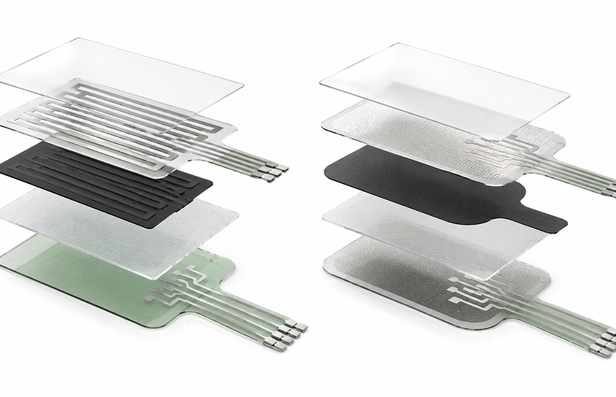
FSR Construction Modes: ShuntMode vs ThruMode
The first way FSR designs differ is construction, how the layers are arranged to sense force.
ShuntMode
A ShuntMode FSR uses printed silver interdigitated fingers on one layer that are shorted, or shunted, by a printed FSR carbon layer on the facing layer. Key traits:
- Detects a wider range of forces with a more linear output
- Generally less costly, thanks to fewer print steps and less ink
- Well suited to applications that need a broad, predictable force response
ThruMode
A ThruMode FSR sandwiches a pressure-sensitive layer between top and bottom conductive layers, so current passes through the thickness of the stack. Key traits:
- More receptive to lighter forces, but can saturate more quickly
- Not limited by interdigitated finger spacing, so it allows smaller form factors
- Requires more silver and carbon ink, which makes it more costly than ShuntMode
In short, ShuntMode favors wide force range, linearity, and lower cost, while ThruMode favors light-force sensitivity and compact designs.
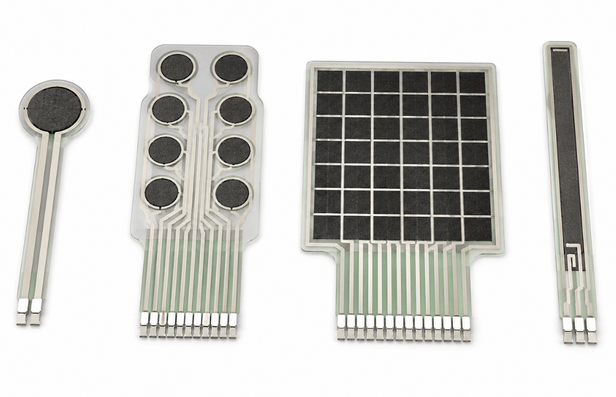
FSR Designs by Configuration
The second way FSRs differ is in configuration, how many sensing points there are and how they are laid out.
Single-Zone
A single-zone FSR has one sensing location with two leads. It is the simplest design and is ideal when you only need to measure force at one point, such as a button, occupancy pad, or threshold detector.
Discrete Array (ShuntMode only)
A discrete array has multiple sensing locations, each with its own trace plus one or more common traces. Because it is built in ShuntMode, it combines several independent force points in one part, useful for reading distinct zones on a single sensor.
Matrix Array (ThruMode only)
A matrix array places many sensing locations at the intersections of rows and columns. Built in ThruMode, it can pack a large number of sensing points into a grid, for example a 16-by-10 layout of 160 points, enabling pressure mapping across a surface.
Linear Potentiometer (Force Slider)
A linear potentiometer senses force along a single axis together with the position of the applied force, effectively a force-sensing slider. It is used for controls that need both where and how hard a user presses.
How the Designs Differ
Put together, the choices come down to a few trade-offs:
- Force range and sensitivity: ShuntMode for wide range, ThruMode for light forces
- Linearity: ShuntMode offers a more linear response; ThruMode has a steeper curve
- Number of sensing points: single-zone for one point, discrete or matrix arrays for many
- Form factor and cost: ThruMode allows smaller shapes but cost
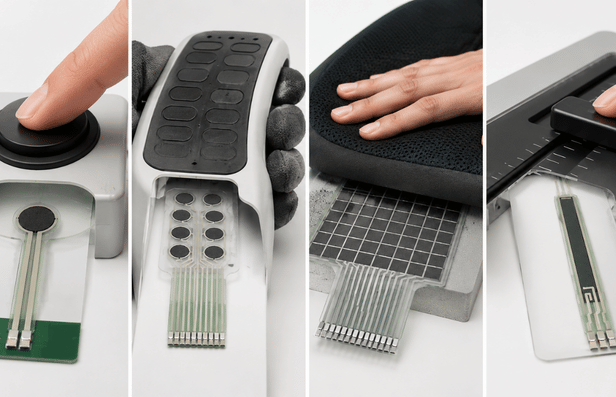
Choosing the Right FSR Design
Selecting an FSR design starts with two questions: what force range do you need to sense, and how many points do you need to measure?
- Wide force range, lower cost, one or a few zones: ShuntMode single-zone or discrete array
- Light forces or a compact shape: ThruMode single-zone
- Pressure mapping across a surface: ThruMode matrix array
- Force plus position on an axis: linear potentiometer
Because FSR ink and layout can be tuned, the best results come from working through the design early and validating it with a design and prototyping review before committing to production.
How Butler Technologies Manufactures Custom FSRs
At Butler Technologies, Inc. (BTI), custom force sensing resistors are engineered in both ShuntMode and ThruMode and in single-zone, discrete array, matrix array, and linear potentiometer configurations, then taken from design through full-scale production.
Capabilities include:
- ShuntMode and ThruMode construction tuned to your force range
- Single-zone, discrete array, matrix array, and force-slider designs
- Carbon ink formulation to adjust sensitivity and response
- In-house design guide support, prototyping, and volume manufacturing
Not sure which FSR design fits your product? Request a quote from Butler Technologies, and our team will help you choose.
Frequently Asked Questions (FAQs)
What are the main types of force sensing resistor designs?
FSR designs differ in two ways: construction mode (ShuntMode or ThruMode) and configuration (single-zone, discrete array, matrix array, or linear potentiometer). Together, these determine force range, linearity, number of sensing points, form factor, and cost.
What is the difference between ShuntMode and ThruMode FSRs?
ShuntMode uses interdigitated silver fingers shorted by a carbon layer, giving a wider force range, more linear output, and lower cost. ThruMode sandwiches the force layer between two conductors, making it more sensitive to light forces and allowing smaller form factors, but it costs more and can saturate sooner.
What is a single-zone FSR?
A single-zone FSR has one sensing location with two leads. It is the simplest design and is used when force only needs to be measured at a single point, such as a button, occupancy pad, or threshold detector.
What is the difference between a discrete array and a matrix array?
A discrete array (ShuntMode only) has multiple sensing points, each with its own trace plus common traces. A matrix array (ThruMode only) arranges many sensing points at row-and-column intersections, which is ideal for pressure mapping across a surface.
Which FSR design is best for light forces?
ThruMode FSRs are more responsive to lighter forces than ShuntMode FSRs, making them the better choice for low-force applications, though they can saturate more quickly.
Which FSR design is more cost-effective?
ShuntMode FSRs are generally more cost-effective because they use fewer print steps and less silver and carbon ink than ThruMode designs.