

Summary
Most touch screen problems begin before production, when the wrong technology, optics, environmental requirements, or manufacturing partner is chosen. For OEMs evaluating a custom touch screen manufacturer, asking the right questions early helps protect performance, durability, quality, lead times, and total cost.
In this blog, you'll learn:
- What questions to ask a custom touch screen manufacturer before ordering
- How to evaluate resistive vs PCAP touch technology
- What to ask about cover lenses, optical bonding, coatings, and display integration
- How to review durability, certifications, tolerances, quality control, and production capacity
- What pricing, sourcing, communication, and project management questions matter most
- How to identify red flags when choosing a touch screen manufacturer
For OEMs, engineers, and sourcing teams, choosing the right custom touch screen manufacturer reduces project risk and helps ensure the final interface performs reliably from prototype through full-scale production.
Most touch screen problems do not start on the production floor. They start much earlier, during the sourcing phase.
A touch panel that delaminates, loses clarity, stops registering touches, or cracks in the field rarely fails because of bad luck. It fails because the wrong technology was chosen, the optics were not specified, the environmental ratings were never agreed in writing, or the supplier's process was weaker than the product needed.
The good news is that nearly all of these issues are preventable, not in production, but in the conversation before the first purchase order. If you are an OEM, design engineer, or sourcing manager evaluating a custom touch screen manufacturer, the questions below separate a reliable, long-term partner from a vendor that simply quotes and ships.
Why the Right Touch Screen Manufacturer Matters
A touch screen is the operator interface. It carries the brand, the controls, and every interaction a user has with the product. In OEM applications it has to stay clear, responsive, and durable through years of touches, cleaning, sunlight, temperature swings, and abrasion. The choice of touch technology and manufacturer shapes warranty, field reliability, and user experience for the life of the product.
Choosing the right manufacturer is not a procurement decision. It is an engineering decision, and the questions below are how you evaluate one.
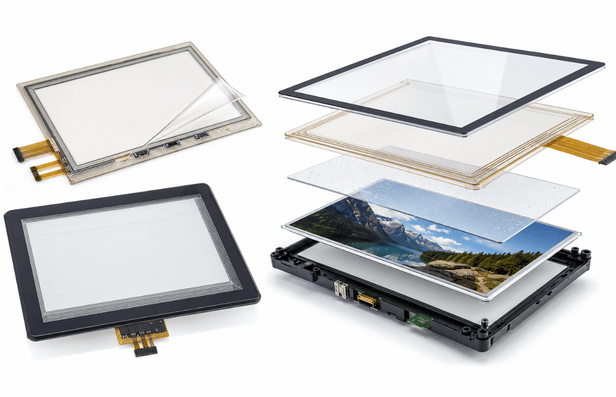
Touch Technology Questions
The technology decides how the screen feels, who can operate it, and how it performs in your environment.
Questions to ask:
- Do you offer resistive, projected-capacitive (PCAP), or both
- For our application, which technology do you recommend and why
- Do you support multi-touch and gestures
- Can the screen be operated with gloves, a stylus, or wet fingers
- How do you handle false input from water, oil, or cleaning fluids
A strong manufacturer will match the technology to the use case: resistive for glove-heavy, single-touch, cost-sensitive designs, and PCAP for premium clarity, multi-touch, and long life. For a deeper comparison, read our guide on capacitive vs resistive touch screens.
Cover Lens, Optical Bonding, and Display Integration Questions
A touch sensor rarely lives alone. How it is bonded and integrated determines clarity, strength, and readability.
Questions to ask:
- What cover lens materials and thicknesses do you offer
- Do you provide optical bonding to remove the air gap and boost contrast
- Can you add anti-glare, anti-reflective, and anti-fingerprint coatings
- Can you integrate the touch sensor with our display, graphic overlay, and bezel as one assembly
Suppliers that build the full stack, touch, cover lens, and graphic overlays or membrane switches in-house tend to deliver more reliable, better-integrated interfaces.
Environmental and Durability Questions
Field conditions, not lab conditions, decide whether a touch screen survives.
Questions to ask:
- What IP and IK ratings can you meet for our environment
- Is the screen sunlight-readable and rated for our temperature range
- How many touch cycles is the sensor rated for
- How do you handle chemicals, washdown, vibration, and shock
Industrial-grade sensors are often rated for more than 10 million touches, and ratings such as the IP code define resistance to dust and water. Confirm these against your real operating conditions, not a datasheet.
Design and Engineering Support Questions
A good manufacturer should make your design stronger, not just build it.
Questions to ask:
- Do you offer design for manufacturability (DFM) review
- Can you support our team during the touch panel design
- What artwork and mechanical files do you require, and what tolerances must they meet
- Will you flag risks (tolerances, adhesives, sourcing) before production starts
A manufacturer that offers real design for manufacturability input will quietly save you money and rework on every order.
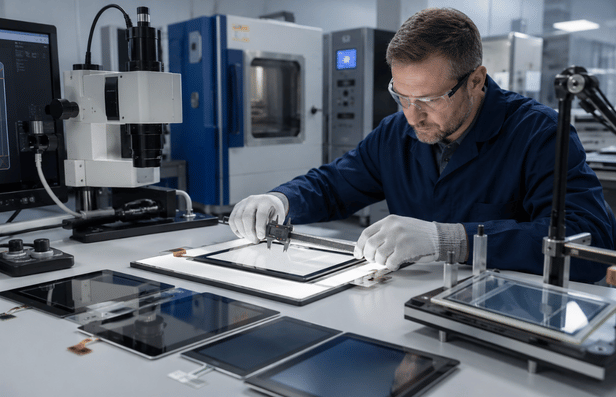
Tolerance, Quality, and Certification Questions
Tolerances and certifications are where vague promises become measurable expectations.
Questions to ask:
- What dimensional and optical tolerances do you hold
- Are you ISO 9001 certified
- If we are in regulated industries, are you ISO 13485 (medical) or IATF 16949 (automotive) certified
- Do you use UL-recognized materials
- What inspection and testing do you perform on every lot
- Can you provide certifications, traceability, and inspection reports
ISO 9001 and industry-specific certifications, backed by documented inspection and traceability, separate a controlled process from a hopeful one.
Production, Capacity, and Lead Time Questions
A great prototype means nothing if the manufacturer cannot scale.
Questions to ask:
- What are your typical lead times for prototypes
- What are your lead times for production runs
- What is your minimum order quantity (MOQ)
- How do you handle rush orders and schedule changes
Ask specifically whether the manufacturer can support the full lifecycle, from prototype to ramp-up to ongoing full-scale production, not just samples.
Pricing and Total Cost Questions
The cheapest piece price is not always the cheapest order.
Questions to ask:
- How is your pricing structured
- What is included in the quoted price (tooling, setup, samples), and what is extra
- Do you offer pricing tiers at higher volumes
- How do you compare on total cost per delivered, accepted unit, including freight and rejects
- Do you support kitting, packaging, and scheduled releases
Supply Chain and Sourcing Questions
A touch screen is only as reliable as the supply chain behind it, including the controller and components.
Questions to ask:
- Where are your materials, cover glass, and touch controllers sourced from
- Are you a touchscreen manufacturer in the USA, or do you produce offshore
- How do you handle component shortages and lead-time changes
- Can you source and qualify custom or hard-to-find components
For OEMs that value tighter quality control, faster communication, and stronger compliance support, working with a touchscreen manufacturer in the USA is often the more practical choice.
Communication and Project Management Questions
Day-to-day communication often decides whether a project ships on time or quietly slips.
Questions to ask:
- Who is our main point of contact during the project
- How do you handle revisions, change orders, and approvals
- How quickly can we expect quotes, samples, and engineering responses
- How do you communicate delays, quality issues, and risks
Industry Experience and References
Experience in your specific industry is worth more than generic claims.
Questions to ask:
- What industries do you typically serve
- Can you share examples of similar custom touch screen projects
- Can you connect us with references in our industry
- Have you supported OEM touch panels for medical, industrial, automotive, or aerospace applications
Red Flags to Watch For
- No DFM input, only price quotes
- No certifications, quality documentation, or traceability
- Vague answers about technology, optics, or tolerances
- Pricing far below market without a clear reason
- Slow, evasive, or inconsistent communication
A Simple Touch Screen Sourcing Checklist
- Touch technology and construction confirmed in writing
- Optics, cover lens, and integration defined
- Environmental ratings and touch life confirmed
- Quality certifications verified
- Tooling, prototype, and approval plan defined
- Lead times, MOQ, and capacity confirmed
- Inspection and quality plan in place
- Communication, ownership, and the escalation path are clear
Applications Across OEM Manufacturing
Custom touch screens are critical across many industries:
- Medical devices and diagnostic equipment
- Industrial controls and HMIs
- Point-of-sale systems and kiosks
- Automotive and transportation displays
- Aerospace and defense interfaces
- Consumer and smart devices

How to Choose the Best Custom Touch Screen Manufacturer
The best manufacturer is not always the largest or cheapest. It is the one that aligns with how you build products.
Look for a partner that offers real engineering depth and DFM support, in-house integration of touch, display, and HMI, technology and optical expertise across PCAP and resistive, quality systems built for regulated industries, scalability from prototype to volume, and honest communication with references.
For a closer look at how these panels are engineered, see our guide on how custom touch screen panels are designed and built.
How We Support OEMs at Butler Technologies, Inc. (BTI)
At Butler Technologies, Inc. (BTI), custom touch screen manufacturing is built around OEM and engineering needs, from design through volume.
Capabilities include:
- All touch screen production is achieved offshore with a trusted, qualified manufacturer.
- Resistive and PCAP expertise with optical bonding and cover lenses
- Integration with graphic overlays, membrane switches, and displays
- Design support, DFM review, and engineering collaboration
- Quality systems for medical, industrial, automotive, and aerospace applications
- Single-partner support from concept through full-scale production
Sourcing a custom touch screen? Request a quote from Butler Technologies.
Key Takeaways
- The questions you ask before ordering decide the reliability of every touch screen you ship
- Technology, optics, durability, and certifications matter more than price alone
- Resistive suits are glove-heavy, single-touch, cost-sensitive designs; PCAP suits are premium, multi-touch, long-life designs
- The best manufacturer acts as an extension of your engineering team
- A short, structured checklist of questions protects budget, schedule, and field performance
Frequently Asked Questions (FAQs)
What questions should I ask a touch screen manufacturer before ordering?
Cover touch technology (resistive vs PCAP), cover lens and optical bonding, environmental ratings and touch life, DFM and design support, tolerances and certifications, lead times and MOQ, pricing and total cost, supply chain, communication, and references. A strong manufacturer answers all of these clearly and in writing.
How do I choose a custom touch screen manufacturer?
Choose based on engineering depth, in-house integration of touch, display, and HMI, expertise across PCAP and resistive, quality systems and certifications, scalability from prototype to full-scale production, and proven references in your industry. Price is one factor, never the deciding one.
Which is better for my application, resistive or PCAP?
It depends. Resistive touch screens work well with gloves and styluses, support single-touch, and are cost-effective. PCAP touch screens offer better clarity, multi-touch, and longer life, and can be tuned for glove use. The right choice depends on your environment, input method, and durability needs.
What is optical bonding and why does it matter?
Optical bonding fills the air gap between the touch sensor or cover glass and the display with a clear resin. It improves contrast and outdoor readability, reduces glare and internal reflections, and strengthens the assembly, which is why it is common in demanding and sunlight-readable applications.
Why choose a touchscreen manufacturer in the USA?
A USA-based manufacturer such as Butler Technologies, Inc. (BTI) typically offers tighter quality control, faster communication, shorter lead times, stronger compliance support, and easier collaboration on design, DFM, and full-scale production, which often outweighs small differences in offshore unit price.