

Summary
A gasket only seals if it is cut accurately, and the cutting method decides that accuracy. This blog compares the main gasket cutting methods used in precision manufacturing: die cutting, laser, waterjet, and kiss cutting, and explains how to match the method to material, tolerance, geometry, and volume.
In this blog, you'll learn:
- Why the cutting method controls how a gasket seals
- How rotary and flatbed die cutting work and where each fits
- When laser cutting is the right choice, and its limits
- Why waterjet suits thick and heat-sensitive materials
- What kiss cutting is and when peel-and-place parts help
- How Butler Technologies, Inc. (BTI) selects the method for the job
Choosing the right cutting method is what keeps a seal consistent from the first part to the last, and this guide gives you a clear way to decide.
A gasket only works if it is cut accurately. The seal it forms depends on clean edges, consistent dimensions, and the right relationship between the part and the surface it seals against. The cutting method determines that accuracy, and choosing the wrong one for the material, tolerance, or volume is a common, avoidable source of sealing failure.
For engineers specifying custom gaskets, filters, and barriers, understanding the main cutting methods and what each is good and bad at is the difference between a part that seals reliably and one that leaks, tears, or costs far more than it should to produce.
Quick answer: The main gasket cutting methods in precision manufacturing are die cutting (rotary and flatbed/steel rule), laser cutting, waterjet cutting, and kiss cutting. Die cutting suits high-volume, tight-tolerance runs; laser cutting suits intricate shapes without tooling; waterjet cutting suits thick or hard materials; and kiss cutting produces peel-and-place parts on a liner. The right choice depends on material, tolerance, geometry, and volume.
Why the Cutting Method Matters
The cutting process controls more than just the outline of the part. It determines:
- Dimensional accuracy and repeatability across a run
- Edge quality, which affects how the gasket seals
- Whether intricate or fine features are achievable
- Tooling cost and lead time
- Cost per part at a given volume
- Which materials and thicknesses can be processed cleanly, classified under ASTM F104 for nonmetallic gasket materials
No single method wins on all of these, which is exactly why several methods exist. Selection is a matter of matching the method to the job.
Gaskets also rarely ship on their own. They are usually specified alongside the membrane switches, graphic overlays, and enclosures they seal against, which means the cut has to hold its tolerance relative to a part made by a different process on a different line.
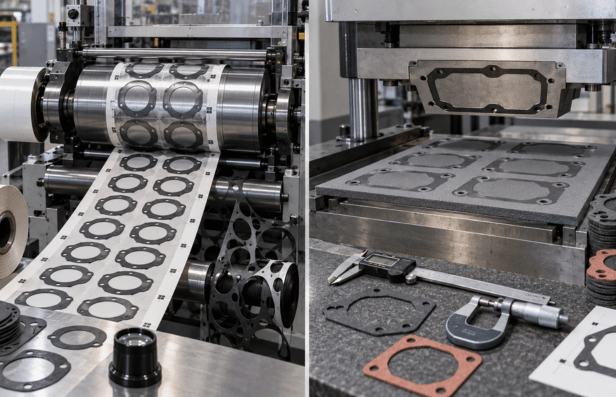
Die Cutting
Die cutting uses a shaped blade or tool to stamp the gasket from sheet or roll material. It is the workhorse of gasket production and comes in two main forms.
Rotary Die Cutting
- Material feeds through a cylindrical die on a rotary press
- Very fast, ideal for high-volume production
- Excellent repeatability and tight tolerances
- Higher tooling cost, offset by low cost per part at volume
Flatbed / Steel Rule Die Cutting
- A flat die presses down through the material
- Lower tooling cost than rotary, good for medium volumes
- Handles thicker materials that rotary cannot
- Slightly looser tolerances than rotary die cutting
Die cutting is the default when volume is high, and the same part is produced repeatedly, because tooling cost is amortised across the run and per-part cost drops sharply.
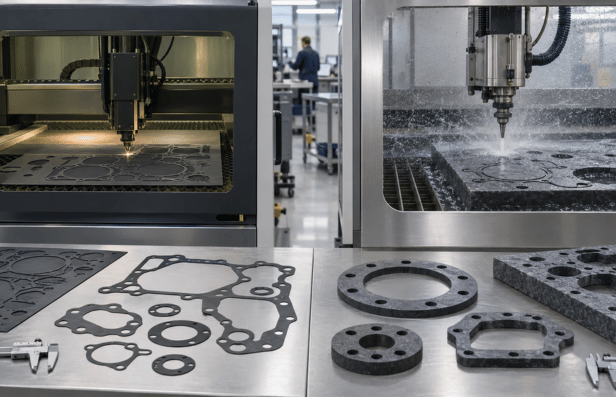
Laser Cutting
Laser cutting uses a focused beam to vaporise or melt a precise path through the material, with no physical tool touching the part.
- No tooling required, so ideal for prototypes and low volumes
- Handles intricate, complex geometries easily
- Fast design changes, since the pattern is digital
- Can leave a heat-affected edge on some materials
- Not suited to all materials, as some react poorly to heat
Laser cutting shines when the geometry is complex, the volume is low, or the design is still changing, because there is no tooling to build or modify between iterations.
Waterjet Cutting
Waterjet cutting uses a high-pressure stream of water, sometimes with an abrasive, to cut through material without heat.
- No heat-affected zone, so material properties are preserved
- Cuts thick, dense, or hard materials that defeat other methods
- No tooling required
- Slower than die cutting for high volumes
- Edge finish depends on material and speed
Waterjet is the method of choice for thick gasket materials, or for materials that cannot tolerate the heat of a laser, where preserving the material’s properties at the edge matters.
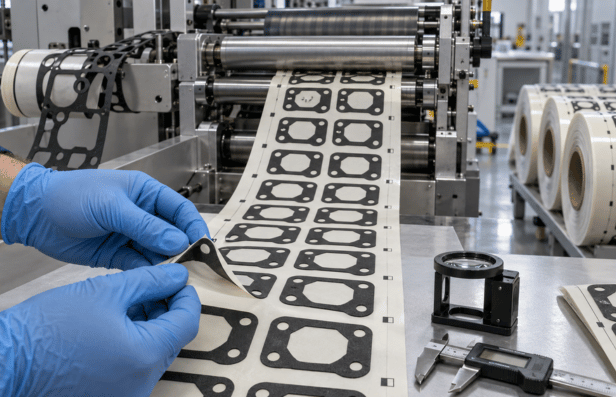
Kiss Cutting
Kiss cutting cuts through the gasket material but not the backing liner beneath it, leaving the part attached to a carrier for easy peel-and-place application.
- Produces peel-and-place parts on a release liner
- Ideal for adhesive-backed gaskets and high-mix assembly
- Speeds up downstream assembly and handling
- Typically combined with die or laser cutting to make the cut
Kiss cutting is less an alternative to the other methods than a variation on them, used specifically when the finished part needs to arrive on a liner ready to apply.
How to Choose the Right Method
The decision comes down to a few practical questions:
- Volume: high volume favours rotary die cutting; low volume favours laser
- Tolerance: the tightest tolerances favour rotary die cutting
- Geometry: intricate shapes favour laser cutting
- Material and thickness: thick or hard materials favour waterjet
- Application: peel-and-place needs kiss cutting on a liner
- Timeline: no-tooling methods win when speed to first part matters
In practice, many parts are best served by combining methods, for example laser cutting a prototype to validate the design, then moving to rotary die cutting for production once the geometry is locked.
How Butler Technologies Cuts Gaskets
At Butler Technologies, Inc. (BTI), gaskets, filters, and barriers are produced alongside broader printed electronics and converting capabilities, so the cutting method is selected to fit the material, tolerance, and volume rather than forcing every job through one process.
Capabilities include:
- Die, laser, and kiss cutting for a range of materials
- Tight dimensional control and consistent edge quality
- Prototype-to-production continuity as volumes scale
- Material selection support for the sealing application, including constructions built to NEMA enclosure ratings
Sealed assemblies are specified across the industries we serve, from medical devices and industrial controls to heavy equipment and defense.
Need a custom gasket cut to a specific tolerance? Request a quote from Butler Technologies, and our team will help you choose the method.
Frequently Asked Questions (FAQs)
What is the most common gasket cutting method?
Die cutting, particularly rotary die cutting, is the most common for production because it is fast, highly repeatable, and inexpensive per part at volume once the tooling is made.
When should laser cutting be used for gaskets?
Laser cutting is best for prototypes, low volumes, and intricate geometries because it needs no tooling and the pattern is digital, so design changes are fast and cheap. It is less suited to heat-sensitive materials.
What is the difference between die cutting and kiss cutting?
Die cutting cuts all the way through the material to produce individual parts. Kiss cutting, a variation of die cutting, cuts through the gasket material but not the backing liner, leaving peel-and-place parts on a carrier for easy application.
Which cutting method is best for thick gasket materials?
Waterjet cutting is usually best for thick, dense, or hard materials, because it cuts without heat and preserves the material’s properties at the edge. Flatbed steel rule dies also handle thicker materials than rotary dies.