We make membrane switches, control panel overlays and equipment labels for solar, wind, battery storage and grid equipment. Every part is built to mount outdoors, stay readable in direct sun and last the life of the installation.
A panel that tests perfectly indoors can be unreadable on a roof at noon. Velvet matte texture kills reflection and legend contrast is set for daylight.
Overlays That Chalk, Fade and Lift Outdoors
Solar and wind equipment sits in full exposure, and a graphic that degrades early becomes a warranty call. Polyester over polycarbonate, tested to SAE J2020.
Sealing an Enclosure That Lives Outside
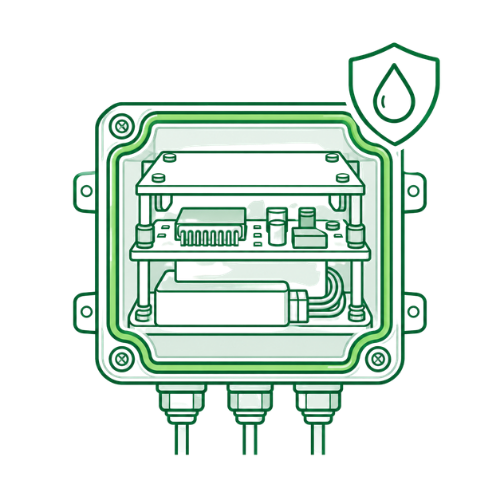
Field equipment meets driving rain, washdown, dust, and condensation. BTI die cuts the gasket alongside the overlay, so the NEMA 4 and IP67 rating is the part's.
Surviving Heat, Cold and Thermal Cycling
Outdoor enclosures move between day and night extremes for years, and adhesive usually fails first. BTI selects from the 3M range for the real substrate.
Plates That Stay Readable for Inspection
A rating plate or arc flash placard that has gone illegible is a compliance problem first. UL 969 evaluates the full construction for permanence and legibility.
Components Your Supplier No Longer Makes
Energy assets stay in service far longer than their suppliers do. Send the part, even a weathered one, and we work from it when documentation is gone.
Sunlight-readable keypads, control panel overlays, and rating labels for string and central inverters, combiner boxes, rapid shutdown devices, and integrated solar energy system controls.
Solar Tracking & Site Controls
Overlays, sealed keypads, and equipment identification for tracker controllers, weather stations, and site monitoring cabinets mounted in open field conditions.
Battery Energy Storage Systems
Interface components and printed heaters for battery management controls and temperature-controlled compartments that have to hold operating range in cold climates.
Wind & Hydro Generation
Nacelle and tower base control panel overlays, sealed switch panels, and rating plates for equipment exposed to weather, vibration, and long service intervals.
Switchgear & Power Distribution
Arc flash placards, electrical rating plates, control panel overlays, and asset labels for switchgear, transformers, reclosers, and substation equipment.
Oil, Gas & Field Service Equipment
Rugged overlays, sealed membrane switches, and equipment identification for wellhead controls, metering skids, and portable field instrumentation.
Most suppliers say weather-resistant and stop. BTI designs for readability: anti-glare texture, legend contrast set for daylight, and backlight matched to mounting.
SAE J2020 UV Tested, Not Just “UV Resistant”
Every supplier claims UV resistance and almost none names a test. J2020 exposes samples to ultraviolet radiation, moisture, and heat together rather than UV alone.
Sealed Assemblies, Not Sealed Components
The overlay, switch, backlighting, and gasket are laminated into one finished sub-assembly rated to NEMA 4 and IP67, so the seal belongs to the part we ship.
UL Authorized Label Supplier
Rating plates, arc flash placards, and equipment identification are built as UL 969 label systems, evaluated for permanence, durability, adhesion, and legibility.
What Our Clients Say
Equipment Manufacturer
Backlit Control Panel That Saved 20+ Hours of Engineering
A manufacturer wanted a control panel with backlighting that stayed even across the whole face. BTI took it from design through production, delivering a production-ready membrane switch that saved the customer over 20 hours of engineering time.
Metal rating plates carry tooling cost, lead time, and weight. BTI redesigned them as printed and embossed labels using metallic inks, holding the original appearance and durability while removing the machining step entirely.
Value-Added Assembly That Removed a Step From the Line
Rather than shipping loose parts for the customer to assemble, BTI laminated the adhesives, spacers, and overlaminate films, surface-mounted the LEDs, fitted the connectors, and delivered a finished sub-assembly ready to drop into the enclosure.
Does BTI make interface components for renewable energy equipment?
Yes. BTI manufactures membrane switches, control panel overlays, equipment labels, printed heaters, and gaskets for solar inverters and combiner boxes, tracker controllers, battery energy storage systems, wind and hydro generation equipment, and switchgear. Everything is built for outdoor mounting and long service life rather than adapted from an indoor construction.
Can a membrane switch be made sunlight readable?
Yes, and it is mostly a printing and finishing problem rather than a lighting one. Velvet matte selective texture in the read area kills specular glare, legend contrast is set for daylight rather than a bench, and LED backlight intensity is specified against the actual mounting orientation. A panel that looks bright indoors is not the same as a panel that is readable on a roof at noon.
How long will an outdoor control panel overlay last?
That depends on the material, the ink, and the exposure, which is why BTI specifies against the environment rather than quoting a single figure. Polyester is chosen over polycarbonate on exposed faces because polycarbonate yellows and embrittles under prolonged UV. Exterior constructions use UV-curable inks with a UV-cured hard coat and are tested to SAE J2020, which combines ultraviolet radiation, moisture, and heat in one exposure.
What sealing ratings can BTI achieve for outdoor energy equipment?
NEMA 4 and IP67. The perimeter gasket is die-cut alongside the overlay and switch and laminated into the finished assembly, using silicone, vellumoid, closed-cell foam, or neoprene depending on the application, so the rating belongs to the part BTI ships rather than to an interface between two suppliers.
Are BTI's equipment rating plates and arc flash labels UL approved?
Yes. BTI is a UL Authorized Label Supplier and builds UL 969 label systems, which are evaluated for permanence, durability, adhesion, and long-term legibility in the intended application rather than just for material approval. CSA-approved constructions are available where the equipment ships internationally.
Can BTI supply printed heaters for battery compartments?
Yes. Screen-printed heating elements are used for temperature-controlled battery compartments and enclosures that need to hold operating range in cold climates. PTC self-regulating constructions have defined operating parameters with no overheating risk, and fixed-resistance constructions are available where the profile needs to be set by the controller.
Can BTI recreate a panel or label set our original supplier no longer makes?
Often, yes. Energy assets outlive their suppliers routinely. Reverse engineering is a standard BTI service. Send a sample, even a weathered one, and we work from the physical part when documentation no longer exists, then put the set back into documented production so batch two matches batch one.
Does BTI supply components rated for hazardous or classified locations?
Ask us before you specify. BTI manufactures the printed interface layers, overlay, switch, gasket, and label, which are passive components. Hazardous location ratings such as Class I Division 2 or ATEX are certified at the enclosure and system level by the equipment manufacturer, not at the component level. We will tell you plainly what we can and cannot support on a classified installation.