How Dial and Gauge Readability Affects Operator Decision-Making

Summary
A dial or gauge is only useful if an operator can read it quickly and correctly. Readability, the combination of contrast, legibility, scale design, layout, and lighting, directly shapes how fast and how accurately an operator makes decisions. When a gauge is hard to read, decisions slow down, errors rise, and safety suffers. This blog explains how readability affects operator decision-making and the design features that make dials and gauges easier to interpret.
Types of Electrodes Used in Printed Biometric Sensors
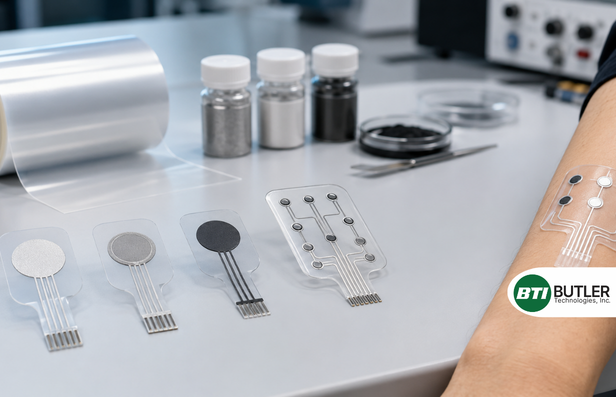
Summary
In this blog, you’ll learn:
Metal Dome vs Polydome Membrane Switches: Engineering Comparison and Application Fit
Summary
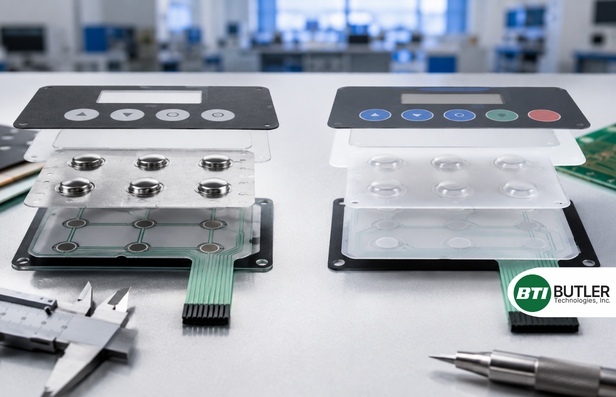
Metal dome and polydome membrane switches both deliver tactile feedback, but they do it in different ways, with different trade-offs in feel, actuation force, cycle life, cost, and environmental resistance. This blog compares the two dome technologies and explains how to match each to the right application.
What Does End-to-End Manufacturing Mean for OEMs

Summary
End-to-end manufacturing is a strategic approach that enables OEMs to manage the entire product lifecycle, from design and prototyping to production, assembly, and delivery, through a single, integrated partner. This model eliminates the inefficiencies of working with multiple vendors and ensures better coordination across every stage of manufacturing.
Key Questions to Ask Your Graphic Overlay Manufacturer Before Ordering

Summary
Choosing the right graphic overlay manufacturer is one of the most important decisions an OEM can make. Most overlay issues that show up in the field, such as fading, lifting, cracking, colour drift, or short flex life, are not random. They trace back to choices made during sourcing, often because the wrong questions were never asked.
What Does Proof of Concept Mean in Manufacturing
Summary
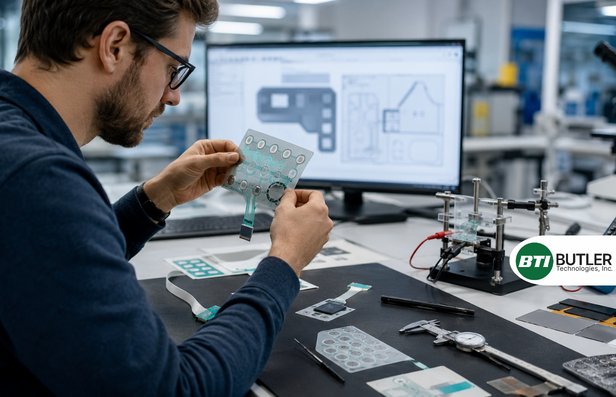
A proof of concept (POC) in manufacturing is an early-stage demonstration that tests whether a product idea, material, or production method is technically feasible — before investing in tooling, prototypes, or full-scale production. It is the first structured “can this work?” checkpoint in the product development lifecycle.