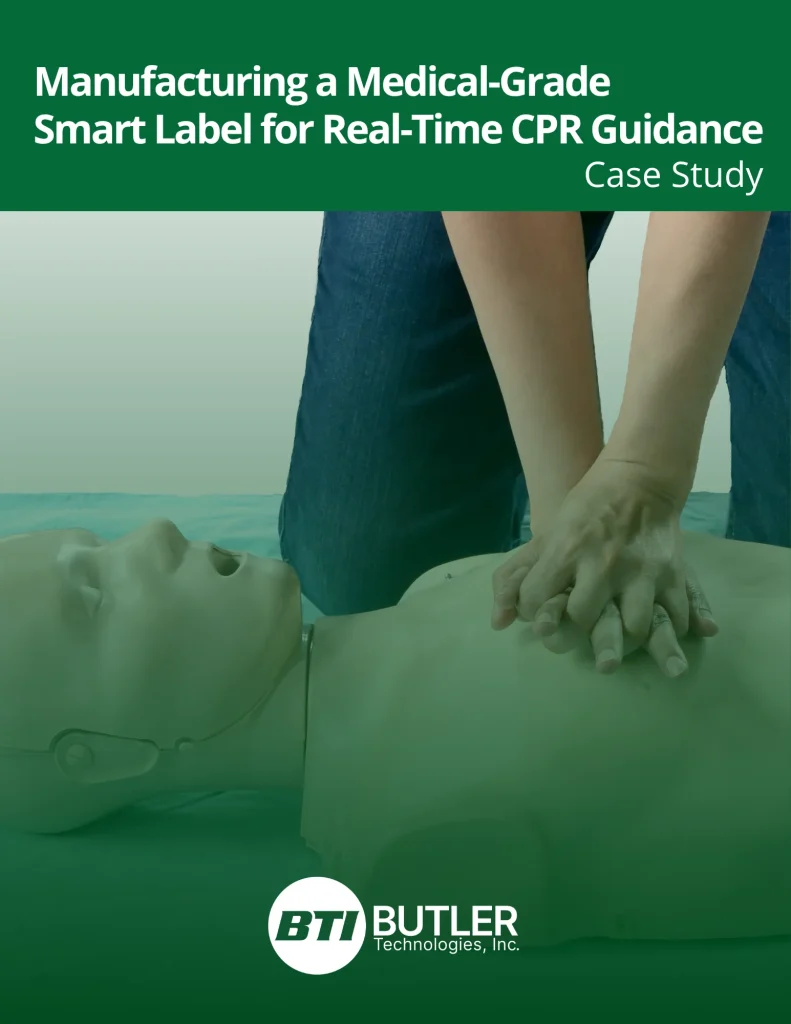
At Butler Technologies, our mission is to provide solutions that improve the lives of others. It’s a phrase we take seriously and through which we evaluate the projects we take on and the partnerships we build. Every so often, a project comes along that embodies that mission so clearly, it reminds us why we do what we do. PaceAid is one of those projects.
When PaceAid first came to Butler Technologies, the idea was simple but powerful. The founder, a practicing clinician, had identified a real problem during resuscitation efforts: even highly trained responders can struggle to maintain proper CPR timing and rhythm in chaotic, high-stress situations. The initial concept arrived as a basic sketch with generic artwork, paired with a patent drawing outlining core functionality. It looked like what we often refer to as a “smart label”—a promising idea without defined dimensions, materials, or a clear path to manufacturing.
From an engineering standpoint, the challenge was intriguing. From a human standpoint, it was compelling.
This wasn’t a consumer gadget or an incremental product upgrade. PaceAid was designed to be used in moments where seconds matter—where clarity, reliability, and simplicity can directly impact patient outcomes. That reality shaped every design conversation we had.
One of the most critical constraints was ensuring the device powered on automatically when the adhesive liner was removed. At the same time, the label had to remain sealed to protect sensitive electronics from bodily fluids, flex comfortably with the human body, and remain non-conductive so it could safely stay on a patient during an AED shock. These weren’t theoretical requirements; they were essential to patient safety and real-world usability.
As development progressed, we evaluated multiple foams and pressure-sensitive adhesives to strike the right balance between flexibility, durability, and skin compatibility. The materials needed to adhere securely for short-term emergency use while remaining gentle on the skin. The foam construction had to encapsulate batteries and circuitry without adding stiffness or bulk. Each decision was made with the patient in mind.
Looking back, the part of this project I’m most proud of isn’t a specific material choice or engineering workaround. It’s the opportunity to use our skills and experience to help bring a customer’s idea to life, especially when that idea is so clearly aligned with improving care in critical moments. Projects like PaceAid are a direct reflection of our mission in action.
If you’d like to learn more about how this collaboration came together—and how printed electronics and thoughtful design helped transform a clinician’s idea into a production-ready medical device—I invite you to read the full case study.