Custom Force Sensing Resistors
Thin, Flexible Pressure Sensors Designed and Printed In-House
What is a Force Sensing Resistor?
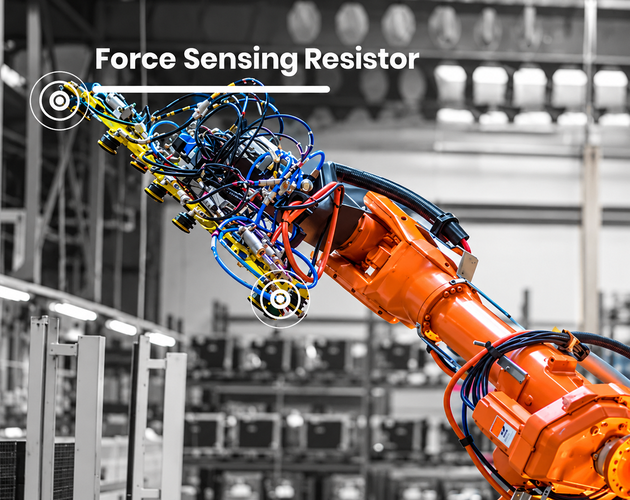
A force sensing resistor (FSR) is a variable resistor, constructed of several thin flexible layers, that vary in resistance as pressure is applied and released. As pressure is applied, the resistance lowers and then returns to its original value as the pressure is removed. An FSR’s main purpose is to measure the force applied to a specific area and then relay that information via selected output electronics.
All FSRs use high-resistance, carbon-based inks which, along with other design factors, can be re-formulated to alter the functionality. FSRs are available in several options including single-zone, discrete array, and matrix array constructions. FSRs are commonly used in Industrial Automation, Healthcare, Transportation, and Wearable applications.
NO STANDARD FSR FITS YOURS?
How Does a Force Sensing Resistor Work?
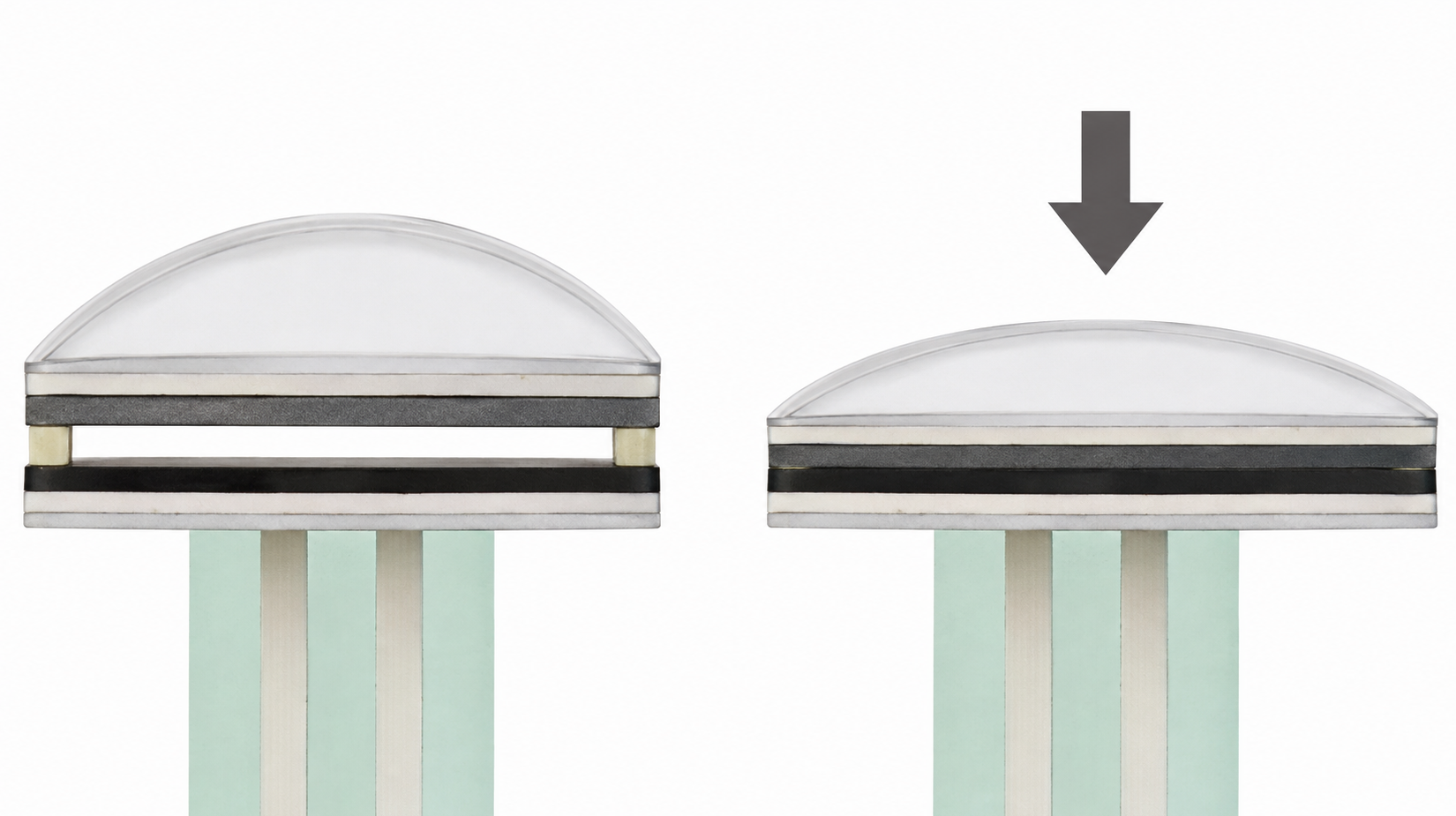
A Force Sensing Resistor works on a simple principle: its electrical resistance falls as force increases.
At rest, the sensor has very high resistance, effectively behaving as an open circuit. When force is applied, the conductive layers are pressed into closer contact with the resistive carbon layer, and resistance drops in proportion to the force applied. Remove the force and the resistance returns to its original value.
A simple circuit reads that changing resistance and converts it into a signal the device interprets as a level of force. There are no moving parts, which is why FSRs can be made extremely thin, remain flexible, and survive millions of actuations.
Force Sensing Capabilities and Applications
Force sensing resistors can sense forces as large as a human body or as light as a vial of medicine.
What Can a Force Sensing Resistor Detect?
- How quickly an applied force changes
- How much an applied force changes
- Whether something has been touched or come into contact with something
- Whether a force has exceeded a predetermined threshold
Examples of FSR Applications
- Up/Down and Force/Speed Controls
- Musical Instrument Controllers
- Infusion Pumps
- Podiatry Foot Gate Analysis
- Motor / Tool Speed Control
- Robotic Finger Tips
- Seat / Bed Occupancy Detection
- Inventory Control
- POS Displays



NEED A CUSTOM FORCE SENSING RESISTOR?
Force Sensor Configurations
FSRs are built in two main constructions. The choice affects the range of forces the sensor can read, how linear the output is, how small the sensor can be, and what it costs.
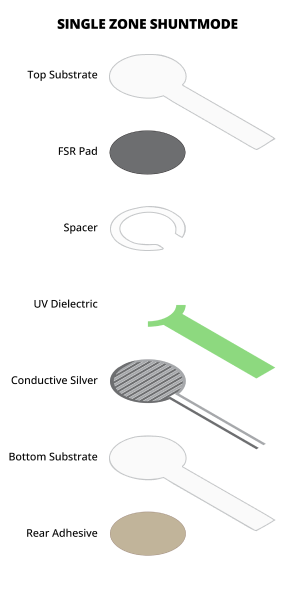
ShuntMode
Capable of detecting a wider range of forces with a more linear output.
- Consist of printed silver interdigitated fingers that are shorted (“shunted”) by a printed FSR carbon layer.
- Can detect a wider range of forces with a more linear output.
- Are generally less costly due to fewer print steps and reduced ink usage.
- Choose ShuntMode for a wider force range, more linear output, and lower cost.
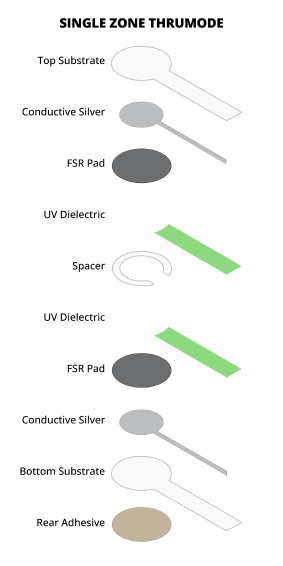
ThruMode
More receptive to lighter forces, but can saturate more quickly.
- Are more receptive to lighter forces
- Not limited to the same print constraints as the ShuntMode’s interdigitated silver fingers, thus allowing for smaller form factors
- Require more silver and carbon ink, thus making them more costly than the ShuntMode FSR.
- Choose ThruMode when the sensor must detect very light forces or fit into a smaller form factor.
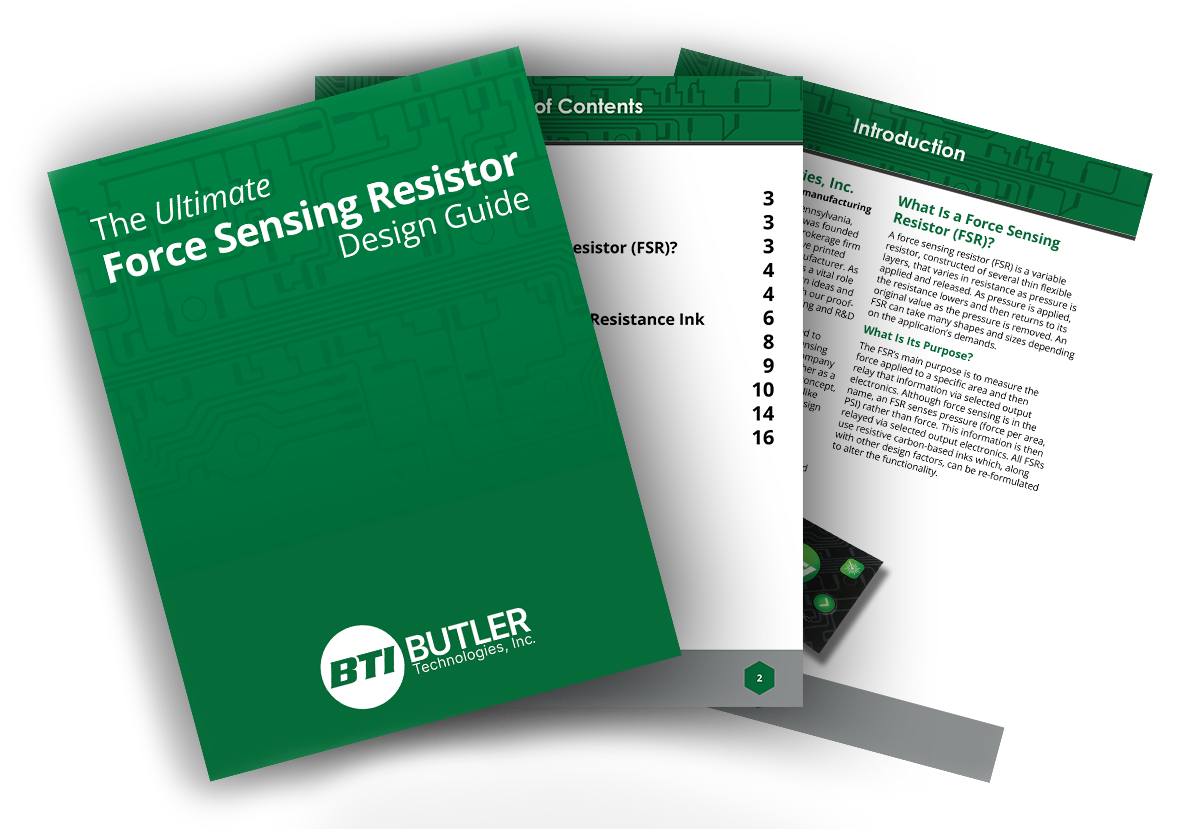
Designing and don’t know where to start?
Check out our design guide. A powerful tool for beginners and seasoned veterans.
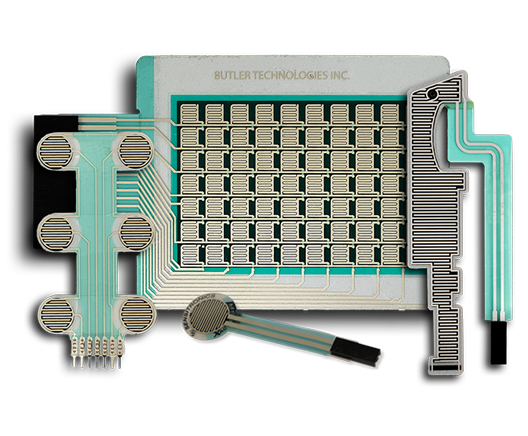
Types of Force Sensors
Single-zone
- One sensing location with 2 leads (traces).
- Choose single-zone when you need to know how much force is applied at one point.
Matrix Array
- Multiple sensing locations connected to rows and columns. (ThruMode only)
- Choose a matrix array when you also need to know where the force is applied.
Discrete Array
- Multiple sensing locations each with its own trace and single or multiple common traces. (ShuntMode only)
- Choose a discrete array when you need to measure force at several separate, predefined locations while reading each sensing point independently.
Linear Potentiometers
- Sense force on a single axis, along with the force applied (a force sensing slider).
- Choose a linear potentiometer when you need position along an axis as well as force.
Industries We Serve
Our products and capabilities support a wide range of industries, each requiring precise manufacturing, reliable performance, and consistent quality across every application.
Why Choose Butler Technologies
ISO 9001 Certified
On-Time Delivery
Design to Production
Supply Chain Simplified
Expert Team
Custom Capabilities
EVERY CLAIM ABOVE IS AUDITED
What Our Clients Say
Frequently Asked Questions
What can a force sensing resistor detect?
How quickly an applied force changes, how much it changes, whether something has been touched or made contact, and whether a force has exceeded a predetermined threshold.
What are force sensing resistors used for?
Common applications include infusion pumps, podiatry foot gait analysis, seat and bed occupancy detection, motor and tool speed control, robotic finger tips, musical instrument controllers, inventory control and POS displays.
Can force sensing resistors be customised?
Yes. The carbon-based inks used in an FSR can be reformulated, and the construction, size, and configuration can be changed, so the sensor response can be tuned to the application rather than fitting the application to a standard part.
Is a force sensitive resistor the same as a force sensing resistor?
Yes. The terms are used interchangeably and describe the same component, a variable resistor whose resistance changes with applied force. Both are commonly abbreviated to FSR.
What is a thin film force sensor?
A thin film force sensor is a force sensing resistor built from thin printed layers rather than rigid components. This construction keeps the sensor flexible and low profile, so it can be placed in applications where a conventional sensor would not fit.
Does Butler Technologies supply the electronics needed to read the sensor?
No. BTI prints and fabricates the force sensing circuit. The readout electronics, wiring, connectors and any software sit with you or a third party contractor. If you have an existing circuit design, we will review it for material set and manufacturability before production.
Where to start
With all the different customization options and use cases, it might seem overwhelming.
Contact our expert team today and take the pressure off yourself.